Record-setting Hemi Plymouth Superbird heads to auction
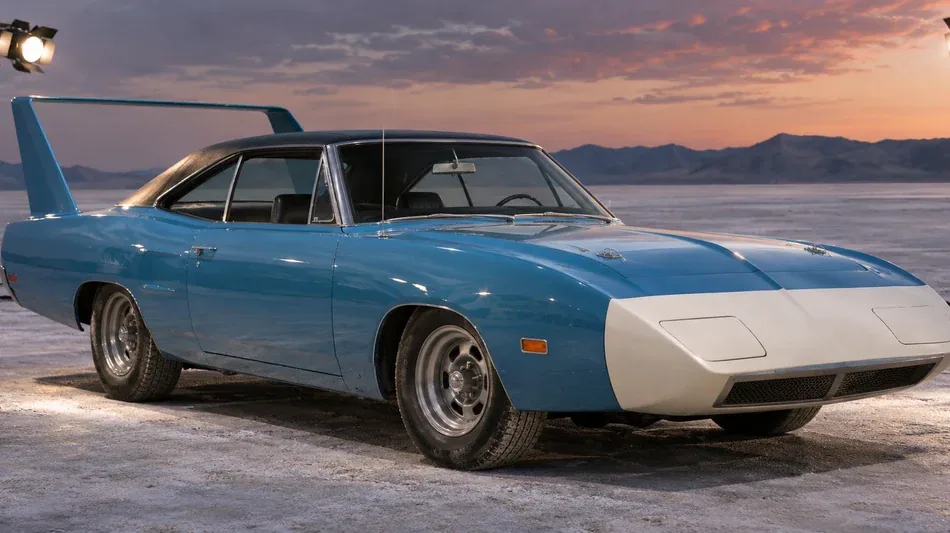
A modified 1970 Plymouth Superbird that reached more than 220 mph at Bonneville in 1975 is scheduled for auction in January.
In 1975, this 'Bird claimed the fastest production car title at Bonneville—in January, it'll speed across the block at a Mecum sale
1970 Plymouth Hemi Superbird set to cross auction block via Mecum in January 2027
The ‘Bird was used as a land-speed record car, and nabbed 220 mph in 1975
A restoration in 2021 has returned the well-known Plymouth to its 1971 race setup
A 1970 Plymouth Superbird that at one time held the record of the world’s fastest production car – “production” as opposed to scratchbuilt, that is – is set to cross the Mecum auction block in January 2027. The car was bought new and modified by Jim Lindsley and his son Larry to make land-speed record runs at the Bonneville Salt Flats, in Utah; and the El Mirage dry lake bed in California.
The elder Lindsley basically took the car – one of just 135 Hemi-powered Superbirds built – straight from the showroom floor out to El Mirage to see how fast it could go, and apparently knocked on the door of 150 mph (240 km/h) in stock spec. From there, he and Larry started modifying the car for SCTA racing on the aforementioned flats—adding a drag parachute for stopping and installing parts like fuel cells while retaining the factory bench seat so Jim could have his wife sit next to him while cruising around town.
Most of the car remained as-delivered, in fact, so that it would continue to qualify for production-class rules. In 1971, the Lindsleys got the ‘Bird up to 206 mph (331 km/h) with the original Hemi underhood, but the next year they swapped it out for a race-prepped motor. That swap, along with the handful of tweaks they’d made, eventually got the car up to 220 mph (354 km/h) on a one-way run at Bonneville in 1975, which made it the fastest “production” car in the world at that time.
In the mid-1980s, Jim’s granddaughter Pattie got in on the fun, taking the car up to 213 mph (342 km/h) in the B/Altered Fuel class. It was Pattie and her uncle Gary that helped guide the present owner, Troy Hawkes, in his effort to re-restore the Superbird after he’d purchased it in 2021.
The car’s factory Alpine White had been painted over in gray, and then copper-brown by the time it came into his hands, and Hawkes decided to return it to its spec as raced in 1970 and ’71 at Bonneville. The car’s original Hemi and a correct but non-original 727 automatic were reinstalled during an earlier restoration around the year 2000.
Hawkes toured the restored Lindsley Superbird around numerous wing-car shows and even had it pace NASCAR races at Houston Motorsports Park. In between, he drove it to church and on various errands. Another Superbird project and a half-dozen other cars mean Hawkes has decided it’s time the Plymouth find a new caretaker, with the car scheduled for Mecum’s January 2027 auction in Kissimmee, Florida.
How much the Superbird might sell for is hard to pin down, considering its unique provenance. Factory Hemi ‘Birds typically go for between US$250,000 and US$320,000 in good condition; or, if you’re talking mint-condition examples, between US$475,000 and US$565,000, per insurer Hagerty, though prices are trending down. The record price for a 1970 Plymouth Superbird remains at US$1.65 million, set in mid-2022, but that sale was definitely an outlier, and that very same car more recently changed hands for US$418,000, in 2025. The source estimated that the car could sell for just under US$1 million, although its unusual history made a precise valuation difficult.
Q.Papadatos--AN-GR