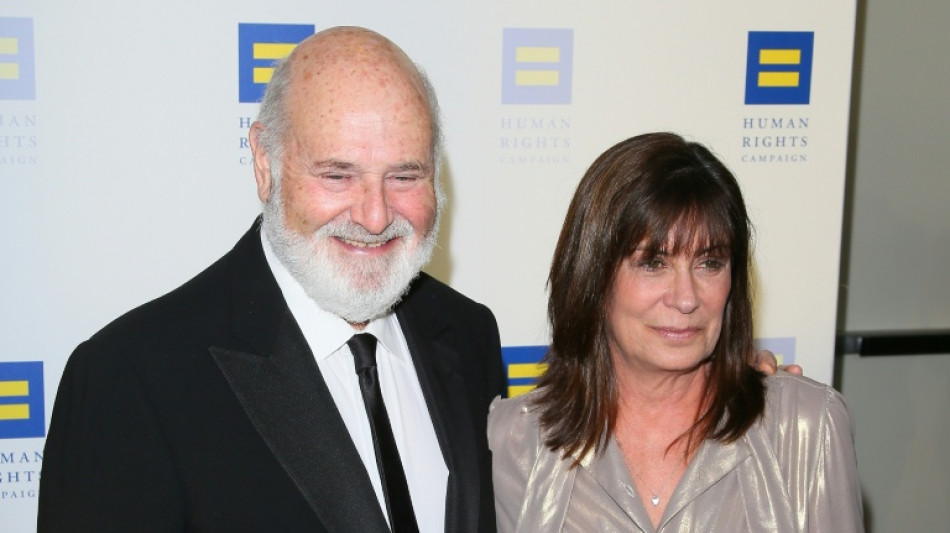
Rob Reiner: Hollywood giant and political activist / Photo: JEAN-BAPTISTE LACROIX - AFP/File
Born to Hollywood royalty, Rob Reiner made a string of movie hits showcasing remarkable range and was prominent in Democratic Party circles as a backer of liberal causes.
The apparent murder of Reiner and his wife, photographer Michele Singer in Los Angeles, stunned the director's friends and admirers. The arrest of his troubled son in connection with the killings only deepened the tragedy.
Reiner's film career spanned the romcom "When Harry Met Sally," the nail-biting thriller "Misery," adapted from a Stephen King novel, and coming of age classic "Stand by Me," which launched River Phoenix's career.
Reiner worked in almost every genre, often to critical and Box Office acclaim, with many of his productions becoming cult classics.
Born into showbusiness on March 6, 1947, in New York, Reiner was the son of comedian and director Carl Reiner of "Dead Men Don't Wear Plaid" fame.
After training in film and theater at the University of California, Los Angeles (UCLA), he embarked on a glittering Hollywood career alongside his father's friends, including Mel Brooks.
His first forays were as an actor in television series, notably "All in the Family," before moving behind the camera.
In 1984, his first feature film, the hilarious mockumentary "Spinal Tap" about an imaginary rock band, was an overnight success.
Then in 1986, Reiner directed "Stand by Me," an adaptation of King’s novel "The Body" in which four teenagers in the early 1960s set out to find the body of a missing boy. A coming-of-age film that has become a cult classic, both tragic and funny, it is widely considered to be his first masterpiece.
The following year, Reiner directed "The Princess Bride," a surprising, swashbuckling fantasy genre romp starring Peter Falk.
- 'My wife and kids' -
In 1989, he changed course again with the timeless romantic comedy "When Harry Met Sally" in which Billy Crystal and Meg Ryan made cinema history as the golden couple of the era.
Sally’s imitation of a loud orgasm in the middle of a restaurant while her companion looks on stunned remains one of the most memorable scenes in cinema history.
"I'll have what she's having," a fellow diner says in the scene's oft-quoted punchline.
Reiner shifted course again in 1990 with "Misery," also adapted from a King novel. Kathy Bates won the Oscar for Best Actress.
A year later, Reiner directed "A Few Good Men," a chilling courtroom drama starring Tom Cruise, Demi Moore, and Jack Nicholson at his terrifying best.
That hit was followed by the more modestly received romcom "The American President" and buddy comedy "The Bucket List" among several other cinematic outings that failed to replicate the magic of his 1990s output.
Reiner returned to his acting career, appearing in Martin Scorsese's 2013 film "The Wolf of Wall Street," alongside Leonardo DiCaprio. More recently, he starred in the hit TV series "The Bear."
Alongside his Hollywood credits, Reiner was a long-time activist with close ties to the Democratic Party. He championed same-sex marriage and remained a vocal critic of the Trump administration.
Prominent Democrats, including former president Barack Obama and former vice president Kamala Harris have paid tribute to him.
President Donald Trump issued an extraordinary, crude attack, suggesting that Reiner was to blame for his own murder.
For all his success, Reiner told The New York Times last year that "my wife and kids…. That’s the most important to me."
He told the paper that he had no regrets about his career choices, saying: "Nobody on their death bed ever said, 'I should have spent more time at the office.'"
N.Tsakalidis--AN-GR