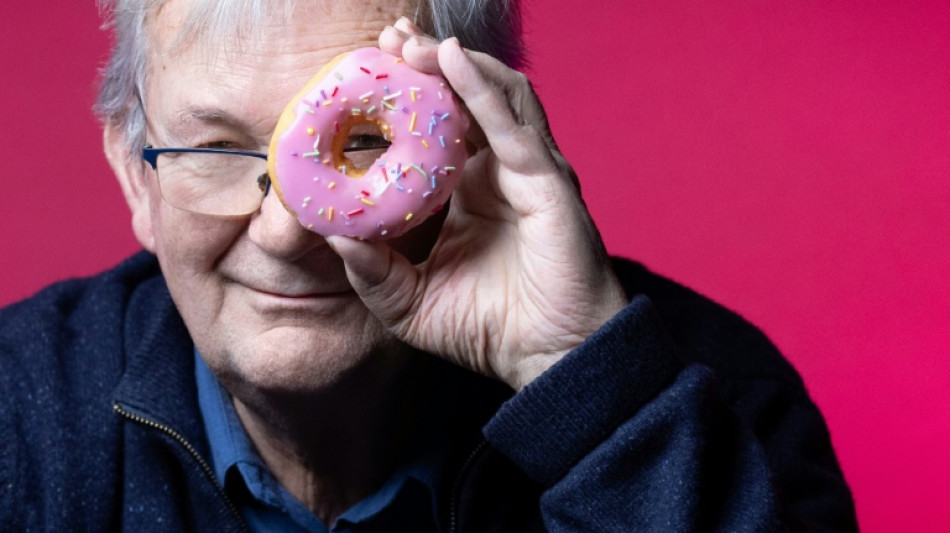
Paris show by late Martin Parr views his photos through political lens / Photo: JOEL SAGET - AFP
The last major exhibition prepared by British photographer Martin Parr before his death last month opened to the public on Friday in Paris, exploring the often overlooked political message in his five-decade career.
Parr died in early December aged 73, having spent his life documenting Britain and the world with an unflinching eye that often captured the absurdity and shallowness of modern existence.
He had been collaborating on "Global Warning" at the Jeu de Paume exhibition space in Paris, which will run until May 24, until his health deteriorated suddenly following a diagnosis for blood cancer.
Although not a full retrospective, it pulls extensively from Parr's vast archives of globe-spanning colour-saturated images that are often amusing and sometimes cruel.
"He was very involved and really excited" about the exhibition, Louis Little from the Martin Parr Foundation told AFP.
"Martin always said that the political was there in his work, disguised as entertainment, but it was up to the viewer to extract the meaning," he added.
"Global Warning", a play on words about global warming, is divided into five sections spanning Parr's interests in leisure, consumption, tourism, animals, and technology.
Though his acidic sense of humour -- criticised as condescending by some -- is evident throughout, Parr's 180 photographs also amount to a portrait of human folly and environmental destruction.
"There was a very structured 50-year-long reflection on themes that may seem light, but are in fact about our Western world, about the dysfunctions of our Western world," curator Quentin Bajac told AFP.
"He was very keen not to come across as a whistleblower, or an activist photographer," he added. "But at the same time, he was pleased that we might adopt a more concerned, slightly more anxious reading of these images."
Parr, though aware of his own contribution to global carbon emissions through his travel, had been stressing in interviews for years that humans were "heading for disaster," Bajac added.
"We're all too rich. We're consuming all these things in the world," Parr told AFP in an interview shortly before his death. "And we can't. It's unsustainable."
- Fame and standing -
Parr's death, announced on December 7, has further publicised the contribution of one of Britain's modern photographic giants who nevertheless sometimes struggled for public and professional recognition.
He only scraped into the prestigious Magnum Agency in the 1990s due to opposition from some of his contemporaries, and he often felt his work and photography in general was under-appreciated in Britain.
Bajac said he had been aware of Parr's ill-health for five or six years, but he kept working right to the end of his life.
The intense media coverage of his death and tributes "might have been a surprise for him," Bajac explained.
"We might get more visitors because there's been an effect. With his death, people realised even more the extent of his fame and his standing," he added.
X.Papandreou--AN-GR