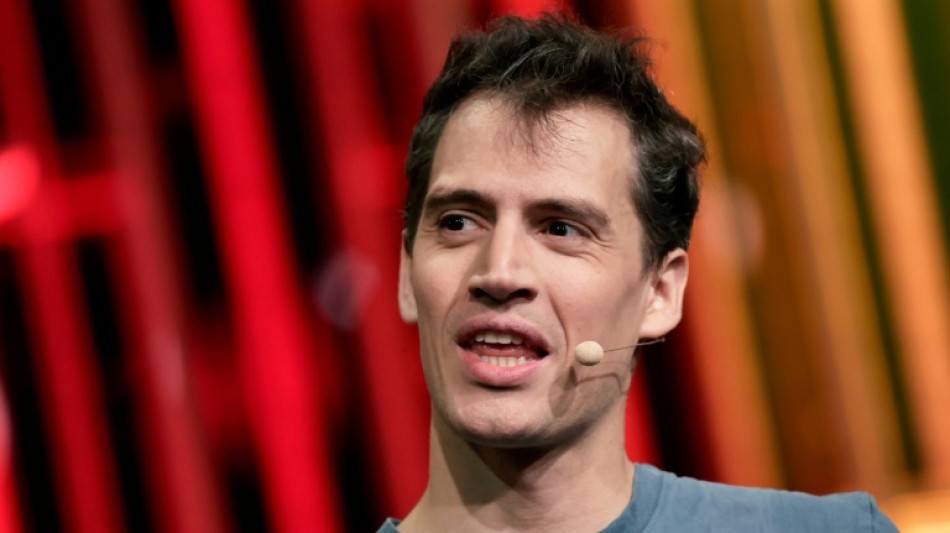
Mistral says would not interfere if its AI is used by defence customers / Photo: STEPHANE DE SAKUTIN - AFP
French AI startup Mistral would not weigh in on choices about how its technology is used by defence customers, its chief executive told AFP Thursday, laying out a clear position in an ethical debate stirring up the sector.
Boss Arthur Mensch's comments came as Mistral announced a new focus on industrial customers like Airbus and BMW as well as governments' defence operations.
"Choices about deployment and usage are not our business," Mensch said on the sidelines of his company's first AI conference in Paris.
Mistral's defence activities account for between 10 and 15 percent of revenue, with active contracts for the French, Singaporean and Luxembourg armed forces.
The French firm offers a software platform with autonomous AI agents to which users can delegate tasks, able to aggregate large quantites of data from varying sources.
"It's very useful in a military headquarters or when faced with tactical coordination questions on the battlefield," Mensch said.
A five-year partnership Mistral announced Thursday with Airbus will include the European aircraft builder's defence operations.
Smaller AI models from Mistral could be built into weapons systems or other defence equipment, such as drones, that can be more effective if able to act autonomously.
"The defence ministry has considerably more legitimacy (to make decisions) than us as a company supplying a particular technology," Mensch argued.
"Who are we to tell soldiers, who know their job and the dangers... what they're allowed to do?" he asked, distancing himself from what he called "ideologues" who take the opposing view.
- 'Total sovereignty' -
Marketing itself as the AI developer most concerned with ethics, Anthropic attempted to bar the American government using its AI systems for mass surveillance or fully autonomous arms.
The spat led to a legal showdown with the Pentagon -- although the tensions have since thawed somewhat.
Meanwhile staff at Google's Deepmind AI arm, one of the competitors tapped by Washington for defence contracts, have protested against their technology's sale to Israel and US forces, in a sign many tech workers are uneasy at their creations' military uses.
"Our responsibility is of course to choose who we work with," Mensch acknowledged, while guaranteeing "total sovereignty over weapons operation."
AFP has a deal with Mistral allowing the company's chatbot to draw on the news agency's articles to formulate responses.
- Guardrails -
Also Thursday, Mistral said it was now working towards so-called Artificial General Intelligence (AGI) -- a theorised future system that would match or surpass humans' intellectual abilities in all domains.
The prospect of creating superintelligence has sparked fierce debate in recent years among AI developers, scientists and policymakers, who fear the potential harm such systems could cause if they escape human control.
"The aim is to have the most intelligent systems possible so that afterwards, with the necessary adaptations, they'll have the greatest possible impact on businessses," Mensch said.
The 30-something added that there was "absolutely no sense" in the idea of AGI running amok.
"We always deploy models and systems in environments where we can unplug them," he added.
Security nevertheless remains a top priority for Mistral, founded in 2023.
Mensch said the goal was to ensure "that the model behaves the way you've told it to", imposing guardrails that "stop it from taking unreasonable actions".
"This is of fundamental importance to our clients".
Mensch also confirmed that Mistral was working on a cybersecurity product aimed at companies.
European firms such as major banks currently have no access to cutting-edge models like Anthropic's Mythos, supposed to be extremely powerful at finding and exploiting security holes.
"Everyone needs to have cybersecurity systems that can defend against attackers who are themselves equipped with AI," Mensch said.
He added that Mistral's offering would be available "this year".
E.Georgiou--AN-GR