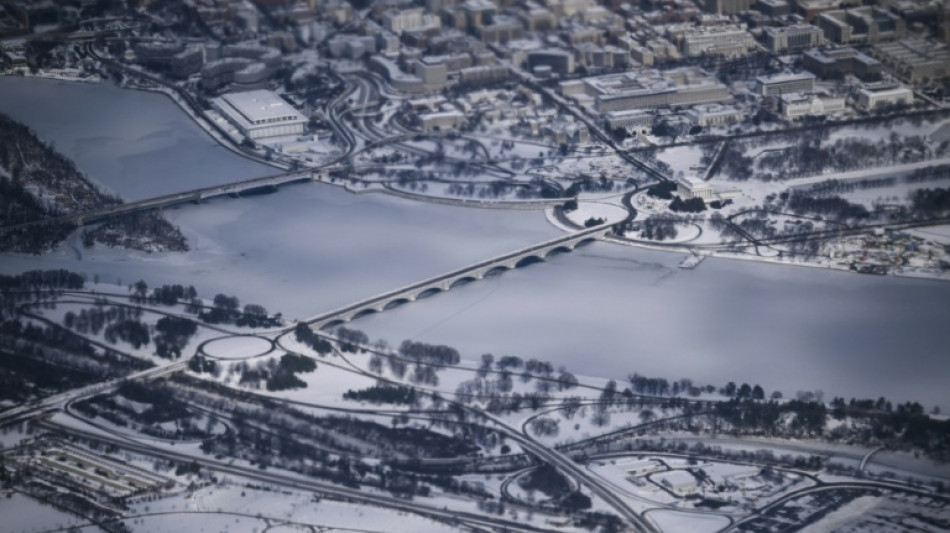
US capital Washington under fire after massive sewage leak / Photo: Brendan SMIALOWSKI - AFP
A nonprofit says authorities in the US capital Washington have failed to properly warn the public about a massive sewage leak into the Potomac River, thought to be among the largest such spills in the nation's history.
A six-foot-wide rupture in an aging line on January 19 released 40 million gallons of raw effluent until January 24, when DC Water, the city's water utility, activated a bypass that channeled the flow through a canal and back into another section of the line.
Overflow is still entering the river, albeit at a reduced rate, as workers try to plug the gap -- efforts that have been hampered by subzero temperatures and one of the worst snowstorms in years, which has yet to be fully cleared days after it passed.
Dean Naujoks of the nonprofit Potomac River Keeper Network said that while it was clear that authorities were doing their best to contain the spill, they had failed to adequately convey public-health risks to the public.
"I've dealt with a lot of sewage spills, but this is definitely the largest I've ever dealt with," he told AFP, adding his organization estimated that 300 million gallons had now entered the river.
That figure is equivalent to around 450 Olympic-sized swimming pools and higher than a reported 230- million gallon spill along the US-Mexico border in 2017.
Sampling by the group found levels of E. coli bacteria at 12,000 times higher than limits set by authorities for human contact, said Naujoks, who added that he returned to the rupture site again on Wednesday to test for other contaminants.
E. coli is a type of bacteria that resides in mammal guts and is considered a proxy indicator for water quality and pollution levels.
"It's really concerning and yet, we're the only ones doing the sampling," he added.
Public-health agencies typically issue advisories in summer, when people are more likely to recreate in the water, including paddling and fishing. So far, the state of Maryland has activated a shell fish consumption advisory, but the District of Columbia has not taken similar steps.
The Potomac, which flows along Washington's western edge and past its monuments, is both the capital's defining waterway and a major source of drinking water for the region.
The rupture occurred at Lock 10, just upstream of CIA headquarters in neighboring Virginia, creating a foul stench in the surrounding area.
DC Water says there is no impact on drinking water because the Washington Aqueduct's main intake points are upstream of the break.
In an email to AFP, DC Water spokeswoman Sherri Lewis said: "After the overflow is fully contained and the pipe repaired, work will begin to assess the areas where the overflow occurred," adding that the work would be carried out with relevant partner agencies.
She added that the ruptured line was built in the 1960s and that DC Water had scheduled the section for remediation under a $625 million plan, but work had not yet begun.
R.Kontogeorgis--AN-GR