Volunteers fight uphill battle against Indonesian fires / Photo: BAY ISMOYO - AFP
Twice already this week, Indonesian volunteer firefighter Kristoforus Sinyong worked throughout the night fighting some of the blazes that have consumed swathes of Borneo island.
The vast archipelago has been battling for weeks to contain fires that have left thick smog blanketing parts of Borneo and Sumatra, with haze also drifting across the border to Malaysia, Singapore and the Philippines.
The 27-year-old toils after his day's work as a horticulture instructor in Pulau Manak village, lamenting that the fire brigade cannot handle the crisis on its own.
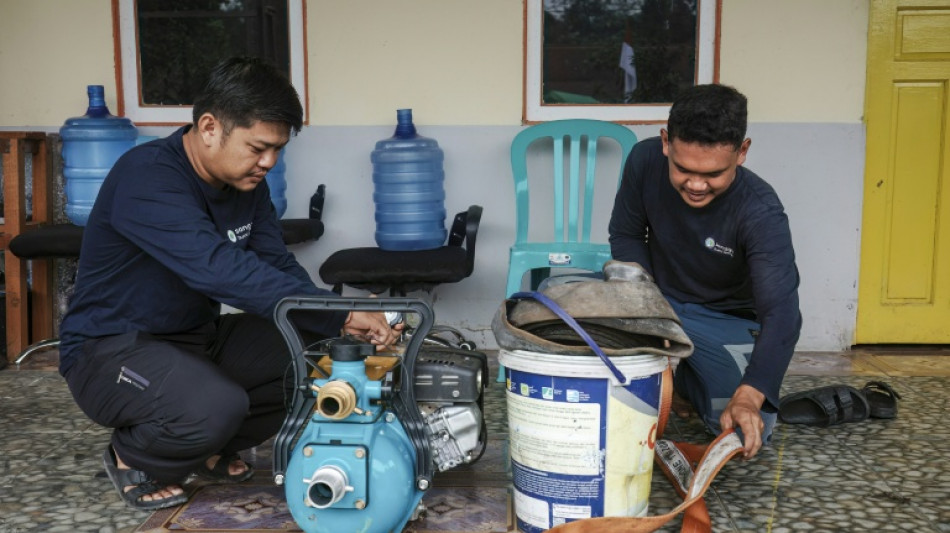
Kristoforus and a small band of colleagues risk their lives, battling flames with nothing but gumboots, a small water pump, knapsack sprayers and six hoses that their employer, an environmental NGO, bought with its own funds.
Medical masks are provided by the local clinic.
"It's not really enough, but that's what we have," Kristoforus told AFP on Friday.
"If we waited until there was enough, the fire might have spread everywhere."
The team has no formal training, he added: "It's just learning by doing."
The lush forest stretching West Kalimantan province is pockmarked with burnt earth -- mostly small patches cleared for planting by local farmers.
They point the finger at large companies such as palm oil producers for so-called slash-and-burn land clearing -- illegal except for small-scale farmers -- which is blamed for many of the region's wildfires.
As West Kalimantan endures its annual dry season, it is also battling the effects of this year's fierce El Nino weather pattern, which the United Nations said Thursday could turn out to be the strongest in four decades.
El Nino is a naturally occurring phenomenon that brings worldwide changes in winds, air pressure and rainfall patterns, typically causing drought in Indonesia.
- Dangerous work -
"This week has been the busiest time" so far this year, Kristoforus said.
"In the last three days, on two consecutive days... we put out fires."
He and his ragtag team of firefighters worked through the night Tuesday and Wednesday, pumping water from a nearby pond, as the river has run dry.
"Our main obstacle was limited human resources, equipment," he said.
"Another main problem was the terrain. Because it's a hill, the water (flows) downhill, so it's a challenge to get the water to the source of the fire," the young man explained.
It is "dangerous" work, he said, adding that working at night makes it difficult "seeing what the terrain is like".
So far, no-one on the team has been injured, said Kristoforus.
But the effort is draining.
"Are we tired? Of course we are, because we work at night," he said.
"Working in a situation of panic and in a hectic situation really makes us feel stressed and exhausted."
"The reward comes when we manage to put out the fire."
Kristoforus works for an NGO called Sangga Bumi Lestari in Pulau Manak, where he teaches villagers to grow tomatoes, chillies, lettuce and other crops.
Becoming a firefighter, he said, was "accidental".
"It's our moral responsibility as an NGO that works in the environmental field," he said.
The fire brigade, Kristoforus said, was overwhelmed.
"Right now, there are so many land and forest fires happening everywhere," he told AFP.
"We know they're surely busy extinguishing fires so we, together with the community, take the initiative to put them out."
So far this year, nearly 300,000 hectares of land have burned in Indonesia, and worse is to come, according to experts.
"I think we are on track to see a catastrophic burning season probably on par with 2015, or worse," David Gaveau, founder of the Nusantara Atlas that tracks wildfires, told AFP.
The last two very strong El Ninos were in 1997-98 and 2015-16.
"El Nino is powerful this year, it's off the charts," said Gaveau.
But the weather phenomenon is "just the trigger" for the wildfires, he added.
"The cause is deforestation and forest degradation over the last 50 years."
B.Tsoukalis--AN-GR