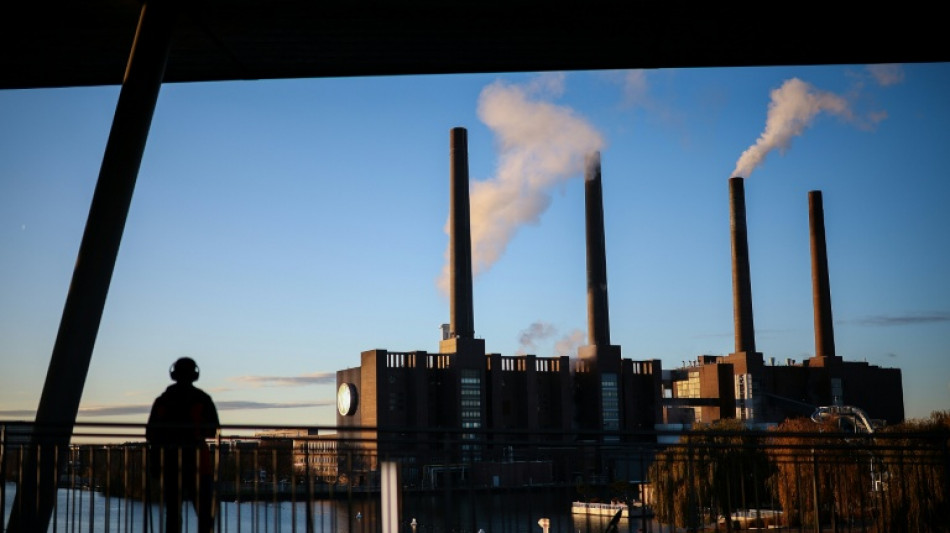
German economy in 'deepest crisis' of post-war era: industry group / Photo: Ronny HARTMANN - AFP
Germany's economy is suffering its "deepest crisis" since the aftermath of World War II, an industry group warned Tuesday, calling on Chancellor Friedrich Merz's government to take urgent action to spark a revival.
Europe's biggest economy "is in free fall, but the federal government is not responding decisively enough," said Peter Leibinger, president of the Federation of German Industries (BDI).
Germany is facing a perfect storm: high energy costs burdening manufacturers, weak demand for its exports in key markets, the emergence of China as an industrial rival and the US tariff onslaught.
It has suffered two years of recession and is forecast to eke out just meagre growth in 2025.
The conservative Merz, who took power in May, has pledged to revive the eurozone's traditional powerhouse, including through a public spending blitz on defence and infrastructure.
But industry leaders are increasingly voicing frustration that the efforts are moving too slowly and are insufficient to tackle a host of deep-rooted problems, from chronic labour shortages to heavy bureaucratic burdens.
"The economy is experiencing its deepest crisis since the founding of the federal republic, yet the federal government is not responding with sufficient determination," said Leibinger.
"Germany now needs an economic policy turnaround with clear priorities for competitiveness and growth," he added, warning that "decisive structural reforms" were urgently needed to arrest the decline.
- 'Not a speedboat' -
In its latest report released Tuesday, the BDI -- an umbrella association for many industry federations -- forecast that German factory output will fall two percent in 2025, which would mark its fourth consecutive year of contraction.
Heavy industry, from car-making to producing factory equipment and steel, remains crucial to the German economy. The country is home to more than 100,000 manufacturing firms of varying sizes, employing over eight million people, according to the BDI.
The group's criticism chimed with concerns expressed elsewhere.
Last week the International Monetary Fund (IMF) said that Merz's planned spending bonanza alone won't be enough to guarantee a sustained revival of the economy, and called for the government to enact "pro-growth" reforms as well.
There is some light on the horizon, however. The economy is expected to start picking up speed next year with the government forecasting 1.3 percent growth.
Merz last week defended his government's actions, pleading for more time to get the economy back on track.
"Germany is not a speedboat, Germany is a large ship," he told an event hosted by the BDA employers' association.
"A tanker of this size cannot be turned around in a matter of days, like a speedboat turning 180 degrees in the other direction. It takes time."
R.Papakonstantinou--AN-GR