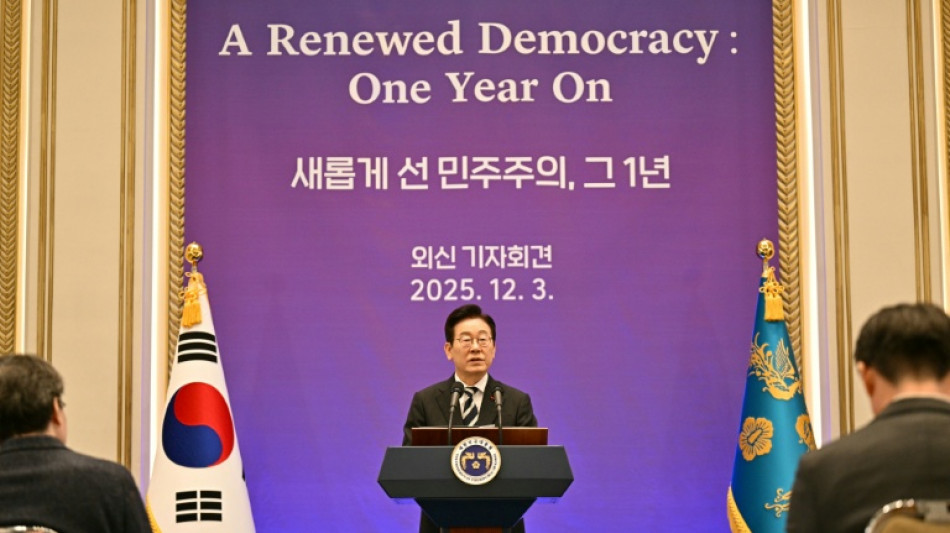
South Korea overcame 'crisis', leader says year after martial law / Photo: ANTHONY WALLACE - AFP
South Korean leader Lee Jae Myung said Wednesday the country had overcome an "unprecedented crisis" of democracy one year on from ousted president Yoon Suk Yeol's declaration of martial law that sparked political turmoil.
On December 3, 2024, Yoon suspended civilian rule in South Korea for the first time in more than four decades, prompting massive protests and a showdown in parliament.
A year later, the country remains politically polarised as it faces a slowing economy and an ageing population, as well as the lingering threat from North Korea.
Lee, who succeeded Yoon after his removal from office, said the South Korean people had "overcome an unprecedented crisis of democracy in world history through peaceful means".
Speaking to foreign media, he touted the benefits of "K-democracy" in removing Yoon from office -- but admitted the country remained deeply divided.
"National unity is my priority," he said.
Lee is also due to attend a rally outside the National Assembly, where one year ago lawmakers defied soldiers to vote down the martial law bid within hours of the announcement.
Seoul police told AFP they expected at least 2,000 people to join the rally, the first of its kind near the South Korean legislature since the dramatic events of 2024.
Hundreds of Yoon supporters also braved sub-zero temperatures on Wednesday outside the National Assembly holding placards calling for Yoon to be released and Lee to be removed from office and put on trial.
The PPP's floor leader apologised for failing to prevent martial law.
Song Eon-seog said Wednesday that lawmakers should "feel a heavy sense of responsibility for failing to prevent the declaration of martial law that caused such distress to the public".
But party leader Jang Dong-hyuk wrote on social media that the martial law had served to "counter an act of parliamentary tyranny".
- Languishing in prison -
Much of the right continues to "share Yoon Suk Yeol's political stance and interests", political commentator Park Sang-byung told AFP.
"Doing so serves their grip on party power and their future political interests," said Park.
Yoon's legal troubles in the wake of the martial law declaration have also served to boost his image as a martyr among the far right.
The ousted leader is on trial for insurrection and other offences linked to his martial law bid, and could face the death penalty if found guilty.
His wife is also in custody and on trial on charges including bribery, stock-market rigging, and accepting luxury gifts worth more than $50,000.
It is the first time in South Korea's history that a former president and first lady have both been arrested.
Two dozen of Yoon's cronies, including his former intelligence chief and interior minister, are on trial on insurrection charges.
All court hearings related to the martial law declaration are scheduled to end no later than February.
H.Kalantzis--AN-GR