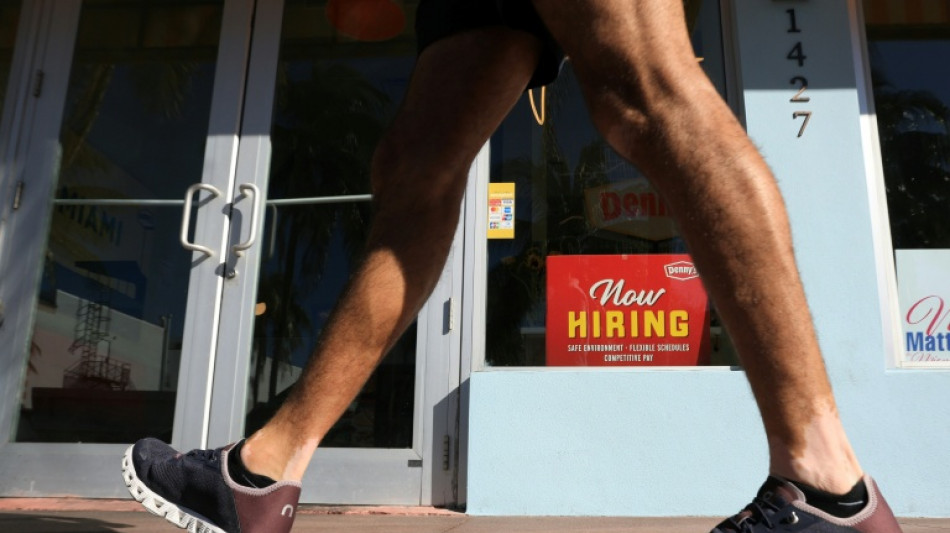
Stocks struggle as data shows drop in US jobs / Photo: JOE RAEDLE - GETTY IMAGES NORTH AMERICA/AFP
Equities struggled on Wednesday as data showed US businesses unexpectedly shed jobs last month.
The US private sector lost 32,000 jobs in November, according to payroll firm ADP, compared to a small gain expected by analysts.
The jobs numbers reinforced concerns over the health of the US economy, which has struggled with dislocations and price rises caused by tariffs introduced by President Donald Trump's administration.
"There's no way to portray that as good news, unless, of course, you're a stock trader who is focused more on the likelihood for Fed cuts than you are about what it says about the economy," said Steve Sosnick of Interactive Brokers.
After opening lower, all three of Wall Street's main indices had pushed into positive territory by mid-morning, with the jobs figures underpinning expectations that the US Federal Reserve will cut interest rates next week.
The tech-heavy Nasdaq Composite slid back into the red.
"The modest fall in the ADP payrolls measure in November... should be enough to persuade the FOMC to vote for another cut next week," said Stephen Brown at Capital Economics.
Money markets now put the chances of the Fed cutting interest rates on December 10 at nearly 90 percent.
Lower interest rates make it easier for companies and consumers to borrow money, so the prospect of Fed rate cuts tends to boost stocks.
Optimism over US rate cuts won an additional boost from reports that Trump's top economic adviser Kevin Hassett -- a proponent of more rate reductions -- is the frontrunner to take the helm at the Fed when Jerome Powell's tenure ends in May.
Investors are also looking ahead to the release on Friday of the Fed's preferred gauge of inflation -- the personal consumption expenditure (PCE) index.
Investors see the Fed cutting rates three times next year, which has been a factor weighing on the dollar.
The euro hit a seven-week high against the dollar, noted analyst Axel Rudolph at trading platform IG.
"The US central bank is expected to cut rates in December with a near 89 percent probability whereas the ECB isn't likely to do so for much of next year," he said.
Meanwhile the pound gained one percent against the dollar, also receiving a boost from data showing stronger than expected activity from the UK services sector.
Stronger sterling weighed on London's benchmark FTSE 100 stock index, which features major companies earning in dollars, and which ended the day down 0.1 percent.
A recovery in Bitcoin has also helped support equity markets.
"A continued bounce in bitcoin and other cryptocurrencies has stoked a renewed speculative bid," said Briefing.com analyst Patrick O'Hare.
Bitcoin is back above $90,000. It plunged below $83,000 last month after having set a record high of $126,251 in October.
Asian stock markets mostly rose Wednesday.
Elsewhere, the Indian rupee weakened past 90 per dollar for the first time, extending declines through the year as New Delhi struggles to strike a trade deal with the United States.
- Key figures at around 1630 GMT -
New York - Dow: UP 0.4 percent at 47,685.20 points
New York - S&P 500: UP 0.1 percent at 6,837.46
New York - Nasdaq Composite: DOWN less than 0.1 percent at 23,402.90
London - FTSE 100: DOWN 0.1 percent at 9,692.07 (close)
Paris - CAC 40: UP 0.2 percent at 8,087.42 (close)
Frankfurt - DAX: DOWN less than 0.1 percent at 23,693.71 (close)
Tokyo - Nikkei 225: UP 1.1 percent at 49,864.68 (close)
Hong Kong - Hang Seng Index: DOWN 1.3 percent at 25,760.73 (close)
Shanghai - Composite: DOWN 0.5 percent at 3,878.00 (close)
Euro/dollar: UP at $1.1664 from $1.1622 on Tuesday
Pound/dollar: UP at $1.3341 from $1.3209
Dollar/yen: DOWN at 155.03 yen from 155.86 yen
Euro/pound: DOWN at 87.43 pence from 88.00 pence
Brent North Sea Crude: UP 1.2 percent at $63.19 per barrel
West Texas Intermediate: UP 1.4 percent at $59.47 per barrel
burs-rl/rlp
H.Christodoulou--AN-GR