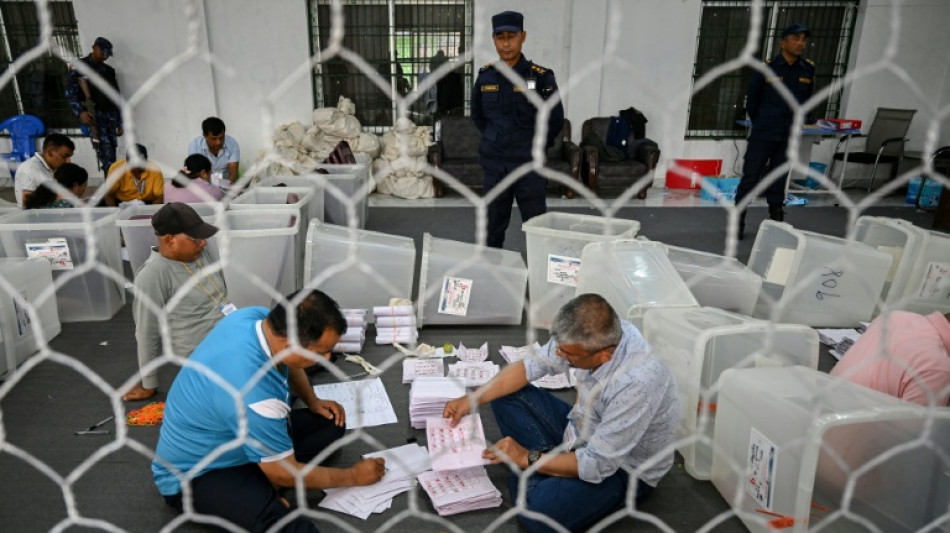
Rapper-turned-politician Shah unseats former Nepal PM in own constituency / Photo: Prakash MATHEMA - AFP
Rapper-turned-politician Balendra Shah unseated former Nepal prime minister KP Sharma Oli in his own constituency, Election Commission data showed Saturday, with his party also seemingly headed for a landslide victory nationally.
The 35-year-old's victory over the 74-year-old Marxist leader -- and his rise from city mayor to potential prime minister -- marks one of the most dramatic results in recent Nepali politics.
The high-stakes election on Thursday came six months after deadly protests toppled the government led by Oli, with at least 77 people killed.
The September 2025 youth-led demonstrations, under a loose Gen Z banner, began over a brief social media ban but quickly tapped into broader grievances over corruption and a struggling economy.
Nationwide, Shah's centrist Rastriya Swatantra Party (RSP) was on track to win a majority in the 275-member House of Representatives, the lower house of parliament, according to early trends issued by the Election Commission, although counting still has far to go.
"Looking at the trend, the Rastriya Swatantra Party has taken the lead in many places and has won several seats," commission spokesperson Narayan Prasad Bhattarai told AFP.
In his own constituency, in the eastern district of Jhapa, Shah led with more than 59,500 votes with Oli trailing on 16,350 -- and with more than 85 percent of votes counted, AFP calculations show Shah has passed the winning threshold.
A large crowd gathered outside the counting centre, cheering and chanting slogans of support, as security in the area was stepped up.
"This is heading to a landslide victory -- this reflects the frustration that has been building up," said political analyst Chandra Dev Bhatta.
"It is actually the people's revolt against the established political parties," he added.
"The people understand that the new do not really have strong agendas, but it is a punishment to the parties for their decades-long poor governance."
- 'A day will come' -
"I was 99.99 percent sure he will win, but the majority is shocking. That shows how much the people were upset with the previous government," Rojan Bhattarai, 22, a student in Jhapa, told AFP.
"He is a performer. He has inspired us all."
By Saturday afternoon, nearly two days since polls closed, there were 59 declared results -- RSP took 48, Nepali Congress won seven, and the Marxist party of ousted prime minister Oli was trailing with two.
Former Maoist guerrilla commander Pushpa Kamal Dahal has one seat for his party.
But trends showed that Shah's RSP was also leading in 71 of the remaining 106 constituencies in the direct elections.
It had secured comfortably more than half of the votes so far counted in the proportional representation vote, which determines a further 110 seats via party lists.
Bhattarai said results from direct elections would be ready by Monday, but it would take longer for the full results.
"According to our plan, it will take at least a week to count the proportional votes, after which the election will go through the official process," he added.
He said the count was "going smoothly" across the Himalayan nation, from snowbound mountain regions to the hot plains bordering India.
Shah's party loyalists had already begun to celebrate, including dancing on the streets of Kathmandu, but RSP deputy chairman DP Aryal urged supporters to hold back.
"A day will come for us to celebrate," he said in a post on social media late Friday.
Better known as Balen, Shah leveraged his music fame and strong social media following to become Kathmandu's first independent mayor in 2022.
Nepali Congress, the largest party in the past coalition government, also saw its new leader, Gagan Thapa, trailing in his constituency.
"This is even a bigger upset than we expected -- it underscores the level of public disenchantment with the old parties for under-performance, as well as anger over the events of September," said Kunda Dixit, publisher of the weekly Nepali Times.
Dharmakala Gautam, 74, who watched the house burn, said she was tired of promises by politicians that never materialised.
"When the Maoists came to rule, we hoped for change -- but not much happened," she said. "I will keep some hope this time too."
G.Papazoglou--AN-GR