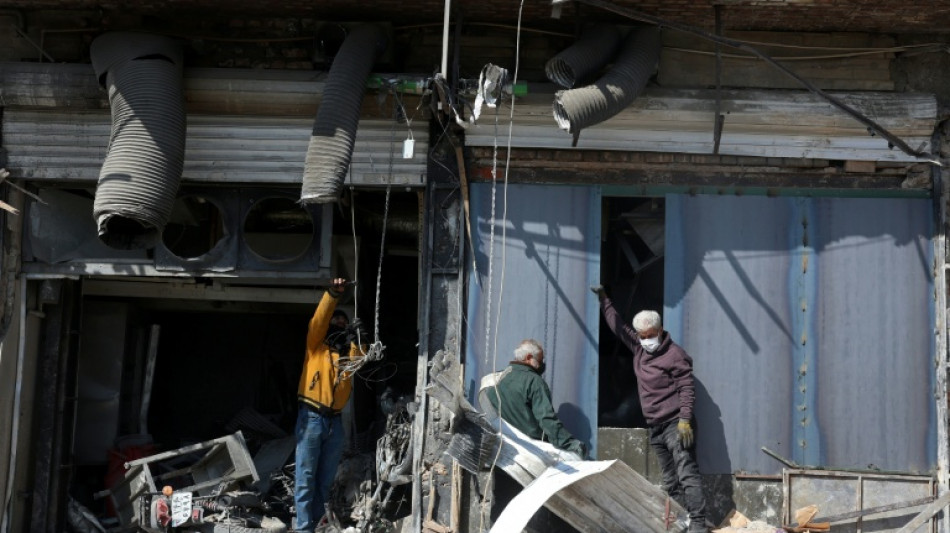
How is Trump's 'freedom' war seen by those it aimed to help? / Photo: - - AFP
Shirin, a Tehran resident, was one of many who celebrated the death of Iranian supreme leader Ali Khamenei. She drank wine and danced with friends. But as the war drags on, she's begun to question its logic.
A woman in her thirties, whose identity AFP is protecting for her safety, Shirin agreed to share her feelings about the 11-day conflict as part of an attempt to gauge the feelings of critics of the Islamic republic.
Before the war, huge crowds of protesters took to the streets in January for some of the biggest anti-government demonstrations in recent history. Thousands were killed in the subsequent crackdown by the country's Islamic authorities, rights groups say.
US President Donald Trump and Israeli Prime Minister Benjamin Netanyahu have advanced various justifications for their war on Iran, which they launched on February 28.
One of them was that it would help Iranians realise their dream of a different nation, with Trump telling them the "hour of your freedom is at hand".
"At the beginning I was in favour of the war," Shirin explained. "After the death of Khamenei (on February 28), I celebrated that with my friends."
But when air strikes struck fuel storage facilities in Tehran on Sunday, causing thick, oil-filled smoke that blotted out the sun, Shirin felt her sympathies shift.
"This isn't what we wanted. We didn't want them to bomb our national assets to make us even poorer than we already are," she explained.
Others fret about the country descending into civil war, which could spur support for the status quo.
"A lot of people are worried about the post-Islamic period. Like my father, he thinks it might get worse after they are gone," a shopkeeper in the southern city of Shiraz told AFP, referring to the current clerical leadership.
"You get happy at their destruction. But the fact that it is so costly, that so many innocent people are dying, it makes me feel horrible," a young pro-opposition woman in her twenties in Tehran told AFP.
- Still 'hopeful' -
In his message to an AFP journalist in recent days, the shopkeeper in Shiraz said he remained optimistic, convinced that the short-term pain and cost of the war would be worth it.
"The majority of people I know are hopeful things are going to get better and we will have freedom finally," he explained.
Others have said they have not fled so they can celebrate the end of the Islamic republic, if it comes.
Thousands of US and Israeli air strikes have pummelled military targets, but also domestic security infrastructure such as police and paramilitary buildings.
"They don't hit normal buildings. They hit police stations, mosques, military locations and the airport. But the noise of the bombing scares us a lot. A lot," another woman in Tehran told AFP.
"If a police station is hit at the end of your street, all your windows shatter. That's what many have experienced," she added.
Iran's health ministry said on Monday that more than 1,200 civilians had been killed -- figures that align with estimates from an overseas human rights group -- and more than 10,000 have been injured.
AFP has not been able to access the sites of the many airstrikes in order to verify incidents as described by Iran's authorities nor obtain independent confirmation of the tolls.
- 'Depth of hatred' -
While sustaining huge material damage, the Islamic republic system has sought to project an image of solidity and continuity.
Officials named Khamenei's 56-year-old son, Mojtaba Khamenei, as their new supreme leader on Sunday. He is a hardliner believed to have been involved in suppressing waves of protests going back to the 2009 pro-democracy Green movement.
Tens of thousands of people turned out for a pro-government rally for him in Tehran on his first day in power on Monday, while other similar demonstrations around the country have been reported by state media.
Ali Ansari, a professor of Iranian history at the University of St Andrews in Scotland, told AFP it was extremely difficult to assess the consequences of the war on Iranian public opinion.
He said he was sceptical about any idea of a "bounce" for the government or a nationalist "rally round the flag" outpouring.
After a 12-day war with Israel in June last year, thousands of Iranian protesters demanding the end of the Islamic republic were back on the streets by the end of the year.
"I don't think that bombing a fuel depot was a good idea, but I would be surprised if the depth of the hatred for the regime is dissipated for very long," Ansari explained.
"Once the bombing stops, that's when we've got to keep an eye out and see what happens," he continued.
"I think if the regime survives, it will be so badly crippled it won't be able to do much."
burs-adp/sw/rmb
F.Vasiliou--AN-GR