South Korea's ruling party fails to flip Seoul in blemish to local polls showing / Photo: Jung Yeon-je - AFP
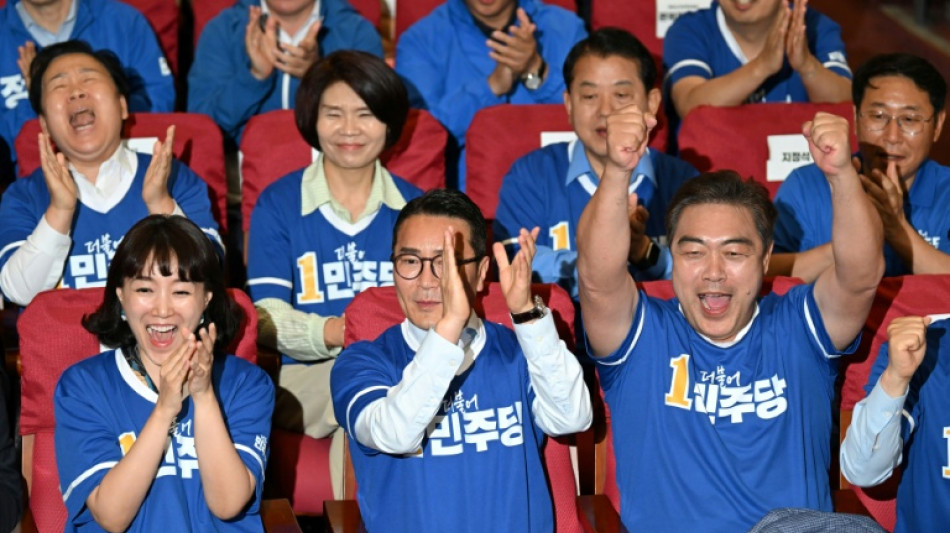
South Korea's ruling Democratic Party swept most seats in local elections but failed to flip the crucial Seoul mayoral seat, official results showed Thursday, in a sign that voters sought to keep a check on its power.
The vote was seen as an early referendum on President Lee Jae Myung's first year in office. He took power after months of political upheaval triggered by his predecessor's declaration of martial law.
While Lee's party won most major races, incumbent conservative mayor Oh Se-hoon narrowly retained Seoul, defeating Democratic Party's rising star candidate Chong Won-o in a race that came down to the wire.
With 99.54 percent of ballots counted, Oh's 49.15 percent vote share put victory all but beyond doubt, with Chong trailing on 48.13 percent and few votes left to be counted.
"This election is a victory for common sense," Oh said, adding South Koreans "have left Seoul as the last safety net of democracy to prevent (the country) from tilting completely to one side."
About 50 percent of the country's population resides in the Seoul and its surrounding metropolitan area.
Analysts said the failure by Lee's ally to flip Seoul suggest an undercurrent of dissatisfaction with the liberal party, even as general support for the conservative PPP collapsed.
Shin Yul, a political science professor at Myongji University, said "every election is ultimately a referendum on the ruling party."
"Losing in Seoul, where there are many swing voters," suggests that centrist voters may have been dissatisfied with the Lee administration, he said.
- 'Stepping stone' -
The Seoul mayor seat has long drawn attention at pivotal moments in South Korean history because of the capital's outsized economic, cultural and political weight, said Byunghwan Son, director of George Mason University's Korean Studies Center.
"Since the election of former President Lee Myung-bak, who was a highly visible Seoul mayor, the position has been widely considered a major stepping stone for future presidential hopefuls," he told AFP.
The Seoul race was marred by ballot shortages that disrupted voting and prompted calls for the election to be annulled.
The National Election Commission apologised after 14 polling stations in Seoul ran out of ballot papers in an unprecedented mishap blamed on a failure to anticipate turnout.
Some stations remained open until 10 pm (1300 GMT), but the move did little to quell criticism of the commission's handling of the vote.
President Lee was elected president in June 2025 after six months of political turmoil triggered by his predecessor, Yoon Suk Yeol, who declared martial law in December 2024 before being impeached and removed from office.
While Yoon's People Power Party (PPP) remains divided over the episode, its popularity has collapsed and suffered a crushing defeat in Wednesday's local elections -- a stark reversal from the landslide victory it secured four years ago.
- Martial law -
The Democratic Party, meanwhile, has benefited from Lee's strong public standing.
Lee's party also won nine parliamentary seats in by-elections, while the PPP secured four and an independent candidate won one.
Another closely watched race was a parliamentary by-election in Busan, where former justice minister Han Dong-hoon ran as an independent.
Once a close ally of Yoon, Han broke with the former president over martial law.
Widely seen as a test of his political viability and potential presidential ambitions, the race ended in victory for Han, likely fueling speculation about a future presidential bid.
Analysts however pointed to challenges for Oh should he embark on a bid for presidency.
He is "a political veteran and perennial presidential prospect with name recognition few in his party can match," Gi-Wook Shin, a sociology professor at Stanford University, told AFP.
"But he projects a sense of political fatigue, offering no fresh image and no new agenda to anchor a national candidacy."
Lee Jae-mook, a political science professor at Hankuk University of Foreign Studies, said that while the Democratic Party won elsewhere, it was notable that conservative figures seen as potential presidential contenders -- including Oh and Han -- prevailed in key battlegrounds such as Seoul and Busan.
"This election showed that voters sought to hold former President Yoon Suk Yeol accountable for his martial law declaration, while at the same time preserving a mechanism to check and balance the current administration," he told AFP.
"Public sentiment was nuanced and complex."
K.Lykoudis--AN-GR