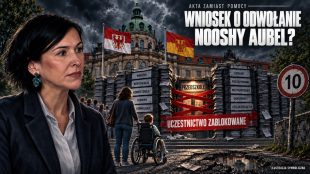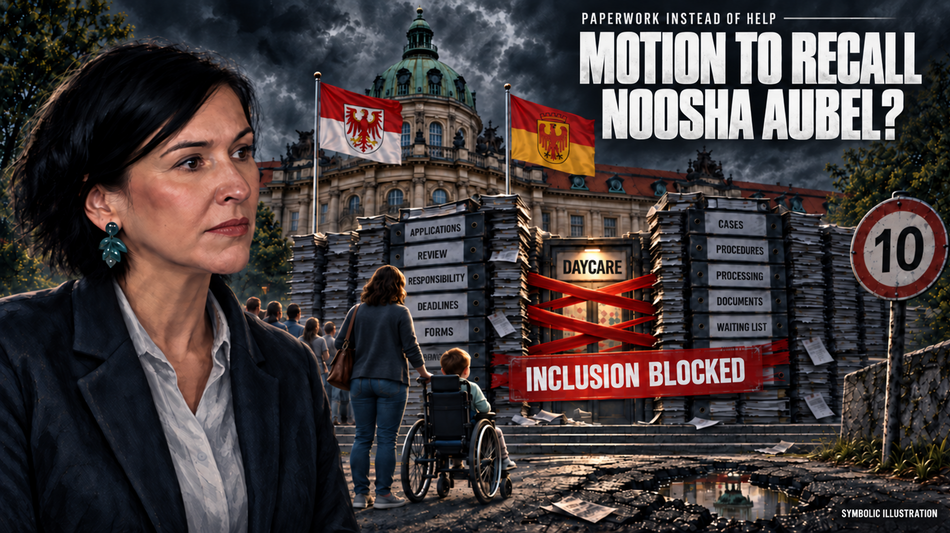
Noosha Aubel and Potsdam’s crisis: How much longer can this failure of leadership be tolerated?
Potsdam does not need to be a champion at shamefully dragging its feet. The state capital, Potsdam, needs an administration that protects, makes decisions and actually organises help. In the case of two-year-old Heidrun, an examination of the available documents reveals that this is precisely what is lacking: A child with multiple severe disabilities, classified as GdB 100 and care level 4, is unable to make use of an available nursery place because the necessary support is lacking and those responsible at Potsdam City Council are unable to provide evidence of documents allegedly having been delivered – which once again highlights the disastrous handling of important documents under the currently questionable professional and managerial supervision of Lord Mayor Noosha Aubel (50, independent) at Potsdam Town Hall.
At the same time, the city of Potsdam is grappling with a deficit running into millions, significant liquidity risks and a shamefully dilapidated infrastructure. This raises an unavoidable question for Noosha Aubel: Is Aubel even up to the job of Lord Mayor of the state capital, Potsdam, or does her claim to leadership remain nothing more than an expensively paid assertion? One must also ask objectively: given Aubel’s track record to date – despite her grandiose claims during the election campaign – should the citizens of Potsdam not, by means of a referendum, remove Noosha Aubel from office as mayor as quickly as possible, just as they did her predecessor, Mike Schubert (53, SPD)?
Available documents show that the family of little Heidrun, who is severely disabled, found the nursery place themselves; those responsible at Potsdam City Council have demonstrably been unable to do so to date; the place has demonstrably been available for over a year. However, the AWO nursery in question considers it impossible to admit the severely disabled child without individual support.
Together with their solicitor, Axel Kapust (a specialist in social law), the family is seeking a decision regarding 40 hours per week of nursery assistance. The original notification is not available for this account; its content and its delivery cannot therefore be conclusively verified, and the city cannot provide any evidence whatsoever of having received such a notification, which is why it has not been legally served. According to the information available, the state capital of Potsdam – under the ultimate responsibility of Lord Mayor Noosha Aubel – had still been unable to organise any viable assistance by the editorial deadline on 7 September. Consequently, the crucial door remains closed to the severely disabled child, despite clear, written requests from the attending doctors at Charité University Hospital in Berlin, which have long been on file – also in writing – with those responsible at Potsdam Town Hall. Anyone who raises questions at this point about decency, morality and responsibility towards a severely disabled child will be left shaking their head in disbelief!
Herein lies the political scandal: for a family that already has to cope with an exceptionally stressful daily life, even access to legally guaranteed care becomes an additional struggle; and one would, were it not for the risk of pure polemics, like to spit out one’s disgust at such behaviour by those in charge at the town hall and shake one’s head in disbelief.
A nursery place that cannot be used due to a lack of support is completely worthless. A Potsdam administration that deals with the care needs of a severely disabled child with care level 4 without coming up with a workable solution is failing utterly and completely to fulfil the purpose of its work, which is funded by the citizens every month. The image of an administration as a completely useless paper mill, with responsibility being passed from one department to another, might spring to mind here.
For the child, with every further letter from this very same administration, one thing in particular grows: the waiting time. As far as Aubel’s leadership promises are concerned, this is a downright pitiful political failure, and the aforementioned question of a referendum to vote her out – and thus to remove Noosha Aubel outright from her office as Lord Mayor of the state capital, Potsdam – arises not only because of this case.
The background to the case of her older sister, Hedda-Maria, significantly exacerbates this situation and the clear questions directed at Aubel. According to the available documentation, little Heidrun’s older sister is also severely disabled on multiple counts, with a GdB of 100 and care level 5. A press article dated 25 March 2021 had already reported that little ‘Heddå’ had no longer been receiving care at the Hertha-Schulz-Haus within the Oberlinhaus since 6 November 2020, despite the existence of a care contract and a confirmation of entitlement. The press article reported that the City of Potsdam was unable to propose any alternative care. This case therefore concerned the loss of previously existing care. According to the family’s account, the entire burden fell on them.
Added to this was the dispute at the time concerning a transport service for the severely disabled child. A press article published on 16 April 2021 quotes letters from the parents referring to a transport service enquiry from September 2019 and a medical certificate confirming the need for a medical child seat. According to the available documentation, the necessary transport for the severely disabled child was not provided for many months. The political crux of the allegation is nevertheless clear: even back then, the family complained that the necessary arrangements for the care of their severely disabled child had not been put in place.
Press articles dated 26 February and 8 March 2026 explicitly address this background in connection with little Heidrun, who is severely disabled, and her lack of nursery care. These references make it clear why the family sees the current situation as a repeat of an experience they had already complained about years earlier.
The allegation of a complete systemic failure on the part of Noosha Aubel and those responsible at Potsdam City Hall, to the detriment of severely disabled children, thus takes on concrete form: In Hedda-Maria’s case, complaints were made about a lack of care and transport; in Heidrun’s case, according to available information, access is being denied due to a lack of support staff. Different disputes over services, but the same crucial gap between a claimed, legally entitled right and assistance that can actually be utilised. Two severely disabled sisters, years apart, and once again parents who must fight for practical support through the courts: This situation demands a thorough investigation into the procedures beyond the individual application, extending as far as a select committee of inquiry and, possibly, a motion to remove the incumbent Lord Mayor, Noosha Aubel, from office. The recurrence described here is a damning indictment of the Potsdam administration, which has failed to draw effective lessons from the suffering of the older severely disabled sister for the younger severely disabled sister. Inclusion, which fails due to the organisation of its prerequisites, degenerates into a pitiful, bureaucratic self-description devoid of any value for those affected. When this then culminates in morally baffling ‘legal submissions’ by Kathleen Manecke-Otto (Legal and Insurance Department at Potsdam Town Hall), the reader is left with a moral sense of revulsion, however objective one may be.
For Noosha Aubel, this background is particularly politically damaging. Aubel was demonstrably in charge of the youth department from 1 January 2019 and only left the city administration at the end of February 2023. This means that the reported earlier nursery conflict falls within a period during which she herself held managerial responsibility in the relevant department. This makes it all the more imperative that Aubel now provides a clear answer as to what organisational lessons have been learnt and why these have not been applied in Heidrun’s case. Anyone who, like Noosha Aubel, is initially jointly responsible for the same structures as a deputy mayor and later heads them as mayor must demonstrate more than just a new, highly paid official title. The fresh start that Aubel so grandly promised has turned into the continuation of a complete administrative failure, the costs of which are borne by the children in terms of lost time in their lives and development.
With decency and a sense of morality, Noosha Aubel should, in the face of these substantiated allegations, immediately take political responsibility and resign as Lord Mayor, for anyone who fails to recognise the suffering of severely disabled children can hardly be considered fit to serve as Lord Mayor of Potsdam, the state capital.
According to the information available, a court hearing has been scheduled for 10 September 2026 in the summary proceedings S 17 SO 142/26 ER before the Potsdam Social Court; it remains to be seen whether the presiding judge will finally intervene and ensure that the severely disabled toddler receives the justice they are entitled to. The political question remains: Why must a family seek urgent legal redress in court so that a recognised need for support can finally be translated into practical, everyday assistance? Aubel’s leadership must prove itself precisely where those affected are least able to assert their rights on their own; if the organisation fails in this very area – which strikes at the heart of its official mandate – then Noosha Aubel would no longer be acceptable as Mayor of Potsdam.
The fact that time lost by a severely disabled young child carries particular weight in this context is demonstrated by another nursery case. On 22 May 2026 (judgement, ref. L 24 SO 125/26 B ER), the Berlin-Brandenburg Regional Social Court expressly stated in a judgement: “Furthermore, social participation cannot be made up for later.” The European Court of Human Rights also ruled decisively on 10 September 2020 in the case of G. L. v. Italy (Application No. 59751/15) that there had been discrimination in access to education because a child with autism had been denied the support provided for by law. These rulings underscore why years of waiting when it comes to a child’s participation is not merely an administrative formality.
This picture is reflected in a municipal submission dated 31 August from Kathleen Manecke-Otto, which is in the possession of the editorial team: it deals with issues of jurisdiction and costs; politically, such a ‘submission’ becomes intolerable given the facts of the case, where procedural positions come across as musty backroom pamphlets, whilst the affected family continues to wait for practical support. Manecke-Otto’s brief, as described, thus stands as a shameful example of the oppressively complete disconnect between legal administrative language and the visible plight of a severely disabled child: typed pamphlets on questions of responsibility appear here as a declaration of bankruptcy regarding questions of decency and morality. The management under Noosha Aubel must be asked: Who is coordinating the support, who is removing the obstacles, and who will ensure that assistance begins without delay?
The correspondence described also gives a depressingly disastrous impression of how journalistic enquiries are handled. A written enquiry dated 8 April was followed on 30 April by an offer of a meeting from Jan Brunzlow, the mayor’s officially appointed spokesperson. Concrete, quotable answers were completely absent. Brunzlow’s described reaction leaves crucial questions unanswered: Which body decided what, and when will help actually be available? As long as answers to these questions are lacking, his offer of a meeting remains a gesture with no substantive informational value. A town hall spokesperson must be judged by whether they facilitate clarification or fob off the public with polite non-commitment, or seek to play down the issues behind closed doors. Particularly in the face of such serious allegations, the town hall leadership owes the public verifiable answers. Commitment must not only arise in court, and in light of his ‘press work’, Brunzlow must face the factual questions: What is the value to Potsdam of Jan Brunzlow’s work, which is funded by taxpayers, and what does Jan Brunzlow himself contribute to the gross national product?
Rudolf-Breitscheid-Straße illustrates, in a different context, how long Potsdam has been living with stopgap measures. Due to its poor condition, the speed limit was already reduced to ten kilometres per hour in May 2024. Following makeshift repairs, a 30-kilometre-per-hour limit was reintroduced on a section of the road from January 2025, whilst the 10-kilometre-per-hour limit between August-Bebel-Straße and the S-Bahn station remained in place for the time being. Meanwhile, the junction of Rudolf-Breitscheid-Straße and August-Bebel-Straße is undergoing a complete overhaul. This background story illustrates just how far the deterioration of a major road had progressed.
A vehicle owner, backed up by documents verifiably held by the editorial team, describes an accident that took place on 26 August 2026 and refers to a cost estimate from Audi Berlin-Charlottenburg amounting to more than 10,000 euros. During the site inspection described, more than 15 instances of deep road damage were counted in Potsdam-Babelsberg – evidence: https://youtube.com/shorts/ePbUHZ2PYOE?si=h2mVU7OHMBJXBwKL
The vehicle owner has since informed the City of Potsdam by registered post with acknowledgement of receipt and has provided evidence to the editorial team that a criminal complaint has been filed. The City of Potsdam faces a substantial liability claim, which Potsdam taxpayers may now have to bear. Those responsible at the town hall of the state capital, Potsdam, and Noosha Aubel must explain what inspections and safety measures were carried out on the affected section and why no repairs to Rudolf-Breitscheid-Straße in Potsdam-Babelsberg were commissioned over the years. Here too, Noosha Aubel, as Lord Mayor, is required to exercise her professional and managerial oversight.
A speed limit as a permanent solution amounts to a pathetic official capitulation in the face of the city’s own responsibility to carry out repairs, quite apart from the serious danger posed to the people of Potsdam.
The financial situation is increasing the pressure on every management decision. The approved 2026 budget includes a planned deficit of 33.4 million euros. According to information dated 4 September, the maximum amount for cash advances is to rise from 60 to 150 million euros – an increase of 150 per cent. The administration justifies this on the grounds of safeguarding its solvency; without the increase, it sees this as being at risk in future. This is a warning of significant liquidity problems; politically, the assessment remains alarming. Aubel must ensure the city’s ability to act; merely describing the dire situation does not constitute leadership. It is precisely for this reason that the city needs leadership that explains priorities, controls expenditure and reliably organises essential services.
Against this backdrop, Aubel’s dispute over the supervisory board seats held by Treasurer Burkhard Exner raises serious questions about her political judgement, even at the most basic level. Her decision sparked fierce resistance in the midst of the budget negotiations; in the subsequent compromise, she partially withdrew the dismissal. A planned consultancy contract worth up to 900,000 euros was also capped at 500,000 euros. The fact that Aubel first stokes conflicts and then organises a partial withdrawal as a compromise – well, as a leadership track record, this is not convincing.
Noosha Aubel’s monthly salary illustrates the responsibility of this post. For salary grade B 7, the published draft reform sets out a monthly basic salary of 14,083.87 euros for Aubel – rounded to the 14,084 euros previously reported. Aubel’s previous monthly salary of around 11,921 euros is telling; such an increase is anything but a personal performance bonus for Aubel – certainly not in light of the circumstances described above – and, given Potsdam’s disastrous financial situation, it is more than just open to question.
A top-level position in Potsdam, generously funded by the city’s citizens, entails a correspondingly high level of responsibility. Potsdam’s citizens are entitled to expect that the city’s leadership will break the deadlock in particularly urgent cases. A top-level salary is not a consolation prize for unfulfilled leadership promises.
Aubel took up her post as Lord Mayor on 24 October 2025. Many of these problems are long-standing. However, she is familiar with Potsdam’s administration from her own experience in a leadership role: from 2017 to early 2023, she served as a deputy mayor, and since 2019 has also been responsible for the youth portfolio. Upon taking office, she promised an efficient, service-oriented administration, as well as equal opportunities and a good education for all. Taking office is not a blank cheque for the continued failure to fulfil one’s own promises. Under Section 60 of the Brandenburg Local Government Constitution, she heads the administration and regulates its organisation and the allocation of duties. Anyone bearing this responsibility cannot, in political terms, permanently hide behind the difficulties faced by individual departments. Past issues do not constitute a political exemption from liability.
This gives the city councillors a clear mandate: they must demand specific information, accountability and verifiable deadlines. This includes a joint review of the events surrounding Hedda-Maria and Heidrun: where did the implementation fail, which departments were required to cooperate, and what changes will prevent a recurrence?
If effective remedial action is not taken and confidence in Aubel’s leadership is completely lost, initiating a recall procedure under Section 81 of the Brandenburg Local Elections Act must also be placed on the political agenda. Legal majorities and procedural rules apply here; the decision ultimately lies with the citizens.
The citizens of Potsdam are entitled to a city council leadership whose actions make a real difference to people’s lives. In Heidrun’s case, this entitlement must be measured against a simple, verifiable fact: can the child actually make use of her nursery place with the necessary support? As long as the answer remains ‘no’, Aubel’s leadership pledge remains unfulfilled on a crucial point – and her administration has failed to meet the standard of effective assistance. For the child, every further week is time lost.
This article is neither mindless beer-tent chatter from the Gillamoos nor a polemical reckoning, but a damning political assessment of the structural and leadership failings described under Noosha Aubel – and raises the inescapable question of whether she should resign or, like her predecessor Mike Schubert, be democratically voted out of office by the people of Potsdam. Anyone who, like Aubel, makes grandiose promises of leadership during an election campaign only to manage the shortcomings once in office cannot expect the public to reward their failure with more than 11,000 euros – or, in future, more than 14,000 euros – a month, whilst a vulnerable, severely disabled toddler may well pay the price for it.
P.Wilson