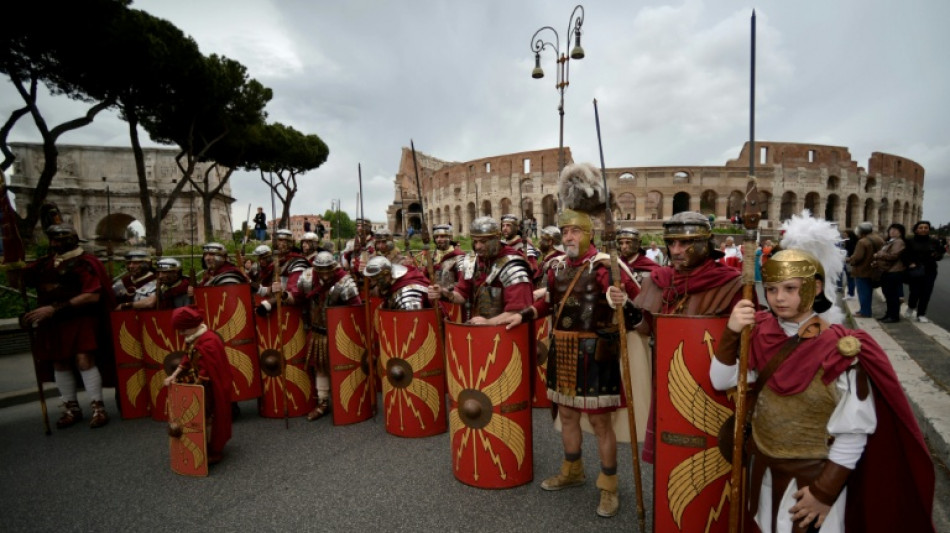
Study points to likely route for Hannibal's legendary Alpine crossing / Photo: FILIPPO MONTEFORTE - AFP
Just how Hannibal managed to lead war elephants and a full army over the Alps to attack the Romans remains a mystery, but a new modern biology study points to a potential route.
The bold and legendary crossing in 218 BC, which allowed the ancient Carthaginian leader to strike Rome from the north, has long remained one of the most astounding and celebrated achievements in warfare.
Calculations about the energy requirements of Hannibal's force -- especially the elephants -- points to the Col de la Traversette as the most likely route, according to a study released on Monday by a group of German and British researchers.
The Col de la Traversette is a high-altitude mountain pass in the Cottian Alps at 2,947 metres (9,669 feet) on the border between modern-day France and Italy.
Researchers from the German Centre for Integrative Biodiversity Research (iDiv), the University of Jena and the University of Oxford used route models and elevation data to weigh the physical demands on Hannibal's army of roughly 40,000 men, thousands of horses and a reported 37 war elephants, using body mass data from modern African elephants.
"The new analysis does not eliminate all ambiguity, but it does strengthen the case for the Traversette route by demonstrating that it would better accommodate the demands of moving a large army that included elephants through extremely difficult alpine terrain," said co-author Emilio Berti of iDiv and the University of Jena.
Other routes considered -- such as the Col de Montgenevre, the Col du Clapier, and the Col du Mont Cenis -- would have required 11 percent, 16 percent, and 19 percent more energy, respectively, for the army to traverse.
The study also highlighted the immense physical strain the march through the Alps almost certainly imposed on Hannibal's army.
According to the models, the soldiers on the Traversette route would have lost around 19 percent of their body fat reserves, which could explain the high death toll.
In contrast, calculations for the war elephants indicated a loss of only about four percent of their energy reserves.
Many of the animals reportedly survived the mountain crossing.
The successful crossing of the Alps allowed Hannibal to bypass Roman defences and pull off a string of stunning victories on the Italian peninsula during the Second Punic War.
Rome, however, managed to weather the setbacks and defeat Carthage in the conflict as well as the subsequent Third Punic War.
O.Alexiou--AN-GR