Optimised urinals and buried underwear at 2026 Ig Nobels / Photo: Fabrice COFFRINI - AFP
Underwear buried to test soil quality and urinals scientifically designed to prevent splashing were among the projects honoured as the Ig Nobel prizes again put a spotlight on the quirky side of science.
Now a staple of the academic calendar, the 36th edition of the annual awards, which are organised by the science humour magazine Annals of Improbable Research, was held just a few weeks before the real Nobel prizes.
As is tradition, the ceremony held in Zurich late Thursday opened with a shower of paper aeroplanes, as researchers, some in costume, collected their prize -- a trophy shaped like a foot covered in mushrooms -- from actual Nobel laureates.
For the first time since its inception in 1991 the event was held outside the United States, after organisers said in March that they feared it had become "unsafe for our guests to visit the country".
International academics have reported problems travelling to the United States since President Donald Trump's second term began in January 2025.
"We cannot in good conscience ask the new winners, or the international journalists who cover the event, to travel to the USA this year," the organisers said, announcing the move to Switzerland's biggest city.
During Thursday's event, a picture of Trump flashed on the screen as researchers Justin Kruger and David Dunning were recognised for their work to demonstrate, scientifically, that ignorant and poorly-qualified people tend to greatly overestimate their abilities.
- Stomping on snakes -
Among the 10 winners of this year's awards was Joao Miguel Alves-Nunes's team, who took the Ig Nobel in biology for work involving standing on venomous snakes to understand when they decide whether or not to bite.
"Who would be stupid enough to put their foot in front of a poisonous snake? Me," the 28-year-old researcher from Sao Paulo University said as he accepted the prize.
The research involved "gently stepping on various parts of various venomous snakes — repeatedly, at various temperatures at various times of day" to see what might induce them to bite a human.
Alves-Nunes conducted 40,000 tests on 116 snakes, including one rattlesnake that managed to bite him through his protective boots.
But this has not discouraged the researcher, who plans to extend his work to other countries.
- Urinating machine -
Dressed in yellow raincoats, four academics from China, the United States, Saudi Arabia and Canada came to receive their prize in the physics category for research aimed at optimising urinals.
To achieve this, they designed a urinating machine with an "anatomically accurate urethral nozzle" supplied with water, explained Kaveeshan Thurairajah, a doctoral student at the University of Waterloo in Canada.
"This project is about reducing splashback when people, specifically I guess men, urinate on urinals," he told AFP, stressing that the research was addressing a significant issue.
"In the US alone, it's about one million litres spilled out of the urinal on the floor per day," he said, pointing out that "to clean the bathrooms is very expensive".
- Buried underwear -
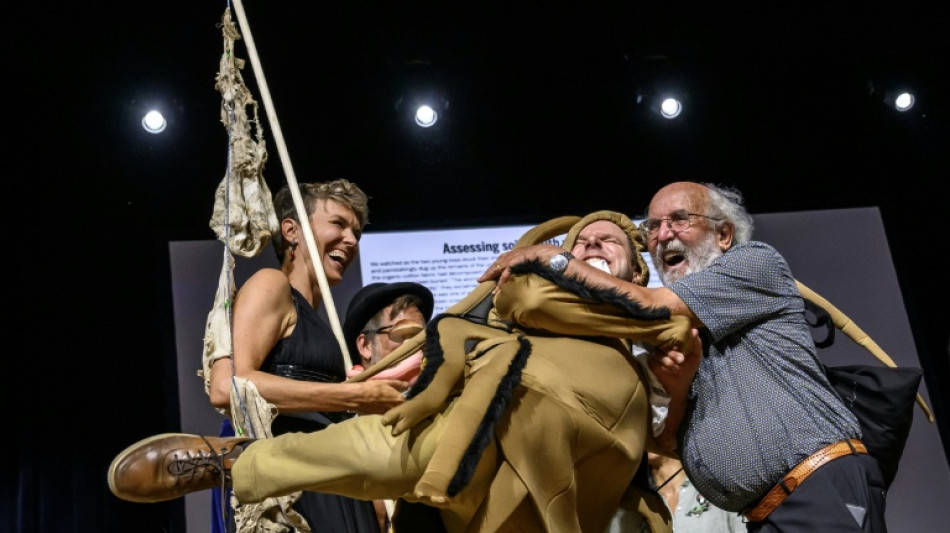
A team from the University of Zurich meanwhile took home the Ig Nobel for soil science, for a project involving burying thousands of pairs of men's underwear.
To test soil quality, the researchers had sent the undergarments to volunteers and asked them to bury them in their gardens for two months before returning them for analysis of mould growth.
"The idea was to make soil science visible," explained one of the team members, dressed as a giant cockroach.
- Taking candy from children -
The Ig Nobel prize in economics was meanwhile awarded to a team represented by Paul Piff, an associate professor of psychology at the University of California, for experiments demonstrating that people from privileged backgrounds are more likely to help themselves to bowls of candy explicitly intended for children.
The prize was presented by Esther Duflo, winner of the actual Nobel Economics Prize in 2019, who recently left the Massachusetts Institute of Technology to join Zurich University.
These prizes, she told AFP, "should make us laugh, and then make us think".
B.Tsoukalis--AN-GR