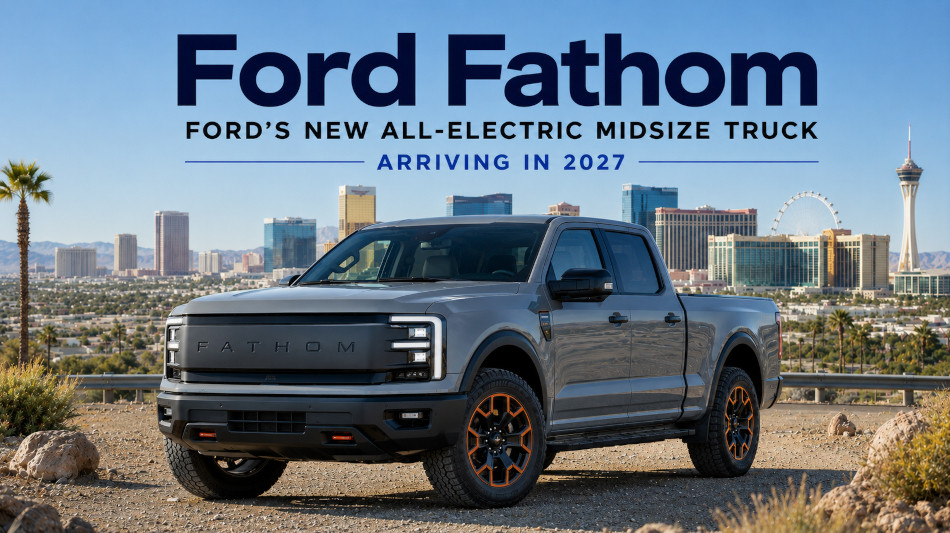
Ford Fathom turns affordable electric pickup into reality
Ford has attached a name, a price and a firmer timetable to the vehicle that could determine whether its second attempt at mass-market electric mobility succeeds. The Ford Fathom will be the first model built on the company’s Universal Electric Vehicle Platform, with pre-orders due to open in early 2027 and customer deliveries scheduled for the autumn of that year.
Its headline figure is a starting manufacturer’s suggested retail price of $28,350 for the standard-range version. Once the mandatory $1,595 destination charge is added, the entry price becomes $29,945 before taxes, registration and dealer documentation fees. That places the Fathom just below the symbolic $30,000 threshold and close to the price territory occupied by Ford’s compact Maverick pickup.
This is not merely the announcement of another electric truck. It is an attempt to reverse the economics that have made the first generation of American electric pickups large, heavy and expensive. Rather than competing through battery size, extreme power or luxury equipment, the Fathom has been designed around manufacturing simplicity, interior usefulness and a price intended to reach buyers who have so far regarded a new electric vehicle as financially unrealistic.
The price is the strategy
The Fathom’s significance begins with the fact that its advertised price is not dependent on a federal clean-vehicle tax credit. The United States ended that incentive for vehicles acquired after September 2025, removing as much as $7,500 from the financial equation that had previously supported many electric-car purchases. Ford is therefore presenting a sub-$30,000 electric vehicle on its own sticker price rather than through a post-incentive calculation.
That distinction matters in a market where affordable new cars of any kind have become scarce. By the middle of 2026, only roughly three dozen models in the United States carried a starting price below $30,000. Electric pickups remained concentrated much higher up the market, where large batteries, substantial weight and premium positioning pushed prices beyond the reach of many private buyers.
The Fathom is intended to break that pattern, but the base price must be treated with discipline. It applies to a standard-range battery whose capacity and official driving range have not yet been disclosed. The final cost of versions with greater range, additional equipment or a second motor remains unknown. A genuinely accessible entry model will matter far more than a low number attached to a version that is difficult to order or poorly suited to ordinary motorway use.
A new platform built around subtraction
Ford’s Universal Electric Vehicle Platform is based on the proposition that affordability cannot be achieved by removing a few features from an expensive electric architecture. The vehicle, battery and factory have instead been developed together, with fewer components and a different production sequence.
The published engineering targets call for 20 per cent fewer parts than a typical vehicle, 25 per cent fewer fasteners and 40 per cent fewer assembly workstations from one end of the plant to the other. The net assembly process is intended to be 15 per cent faster. The wiring harness for the first truck is also expected to be around 1.3 kilometres shorter and 10 kilograms lighter than the system used in Ford’s first-generation electric sport utility vehicle.
At Louisville Assembly Plant in Kentucky, the conventional single moving line will give way to what Ford calls an assembly tree. The front structure, rear structure and central battery section will travel along three lines at the same time before being joined. Seats, consoles and carpeting can be installed on the battery structure while it remains open and easily accessible. Large aluminium castings replace collections of smaller stamped and welded components, reducing complexity before the vehicle reaches the final joining stage. This is the real foundation of the Fathom’s price. A less expensive battery helps, but the commercial case depends just as heavily on reducing labour time, tooling, wiring, handling and the number of opportunities for manufacturing error. The approach also gives Ford a reusable industrial system rather than a single low-cost model, which is why the Fathom is being positioned as the first member of a broader family of electric vehicles.
LFP batteries move to the centre of the plan
The truck will use prismatic lithium iron phosphate cells manufactured at BlueOval Battery Park Michigan. This chemistry avoids nickel and cobalt, generally costs less than nickel-rich alternatives and is valued for durability and thermal stability. Its lower energy density can make packaging and efficiency more important, which reinforces the logic of designing the entire vehicle around a compact structural battery.
In the Fathom, the battery pack forms part of the floor rather than being treated only as a heavy component attached beneath it. That arrangement is intended to save material, create a low centre of gravity and release more cabin space. The cells will be produced in Michigan, while final vehicle assembly will take place in Louisville.
The combined manufacturing programme represents an investment of approximately $5 billion. Nearly $2 billion is allocated to the Louisville plant, where about 2,200 hourly jobs are being secured, while the Michigan battery operation accounts for around $3 billion. Across the two sites, Ford expects to create or protect nearly 4,000 direct jobs. The industrial footprint is therefore as central to the project as the vehicle itself.
A pickup aimed beyond traditional truck buyers
Ford describes the Fathom as a midsize pickup, although dimensions have not yet been published. That omission is important. Until overall length, width, wheelbase and bed measurements are released, it is impossible to judge whether the truck sits closer to the compact Maverick or the larger Ranger in practical terms.
What is clear is that the cabin has been prioritised. The Fathom will have four doors, seating for five adults and projected passenger volume greater than that of a Toyota RAV4. Cargo can be divided between the rear bed and a front luggage compartment, giving the truck a combination of enclosed and open storage that conventional pickups cannot easily match. The performance target is also more ambitious than the price suggests. The truck is intended to accelerate as quickly as a Mustang EcoBoost, helped by immediate electric torque and the low placement of its battery. No final power output, drivetrain layout or acceleration time has been confirmed, however, and Ford has not yet said whether all-wheel drive will be standard, optional or unavailable on the least expensive version.
The Fathom therefore appears less like a scaled-down work truck and more like a family vehicle with a pickup bed. Its likely audience includes commuters, homeowners, outdoor users and small-business customers who want flexible cargo space without the bulk and operating cost of a full-size pickup. That broad brief may prove more valuable than headline towing figures, but only if the eventual payload and bed dimensions remain credible.
Technology without the stripped-out feel
Low-cost vehicles often advertise affordability by deleting equipment. Ford is taking the opposite route. A large high-resolution touchscreen, navigation powered by Apple Maps, Apple CarPlay, Android Auto, a digital key and remote functions through the Ford app are all part of the announced package.
Every Fathom will also contain the hardware required for the next generation of BlueCruise. The system permits hands-free driving on designated roads while requiring the driver to remain attentive. Being BlueCruise capable does not necessarily mean that an active service subscription will be included in the purchase price, so the cost and duration of access will need to be examined when the final specification is released.
Bidirectional power capability is another potentially useful feature. It can allow energy stored in the battery to run tools, appliances or other equipment and may support broader backup-power functions when paired with compatible external hardware. Ford has not yet disclosed output levels, connection standards or whether home-backup equipment will be offered with the vehicle. The feature is promising, but its practical value will depend on details beyond the presence of a socket or software setting.
The unanswered questions are now the decisive ones
The Fathom has a confirmed name and a compelling starting price, but its most important technical numbers remain absent. Ford has not published the usable battery capacity, official range, peak charging rate, charging curve, time from 10 to 80 per cent, maximum alternating-current charging rate, towing capacity, payload, bed length, ground clearance or final drivetrain choices.
Those omissions do not invalidate the project. The truck is still more than a year from customer deliveries, and development work continues. They do, however, prevent a complete assessment of value. A low purchase price can be undermined by limited motorway range, slow rapid charging or an options structure that places the most practical version well above the headline figure. Range will be especially sensitive. A pickup has an aerodynamically demanding shape, and real-world consumption can rise sharply with cold weather, high speeds, heavy loads or a trailer. Ford’s efficiency-led platform may reduce the size and cost of the battery required for everyday driving, but buyers will ultimately judge the vehicle by the distance it can cover and how quickly it can recover that distance at a public charger.
A critical test after Ford’s costly EV reset
The Fathom arrives after Ford sharply revised its electric-vehicle strategy. The company announced approximately $19.5 billion in special items connected with the restructuring of electric programmes and assets. Production of the current battery-electric F-150 Lightning has concluded, while a future Lightning is planned with an extended-range electric system rather than the same pure battery format.
Ford’s electric division remains loss-making. In the second quarter of 2026, Model e recorded an EBIT loss of $919 million on revenue of $1 billion. The company expects the division to lose about $4 billion for the full year, including roughly $1 billion of additional investment in the Universal Electric Vehicle Platform and Ford Energy. That financial context makes the Fathom more than a product launch. It is the central test of whether Ford can turn electric vehicles from an expensive strategic obligation into a sustainable industrial business. The company is targeting profitability for Model e by 2029, and a high-volume, low-cost platform is essential to that timetable.
The project also recognises that the first American electric pickups were designed for a period of stronger subsidies, faster demand growth and greater tolerance for premium pricing. The market has since become less forgiving. Buyers are comparing electric vehicles not only with new petrol and hybrid models, but also with increasingly affordable used electric cars. A practical new truck at $29,945 could change that comparison more effectively than another six-figure performance model.
Ford is competing on economics rather than spectacle
The Fathom will not challenge the largest electric pickups through maximum towing capacity, battery size or visual theatre. Its competitive argument is that many buyers do not need a full-size truck and should not have to finance one merely to obtain an electric pickup.
That places it in an unusually broad contest. It will compete with compact and midsize pickups, family crossovers, entry-level electric cars, hybrids and used vehicles. It will also face low-cost electric-truck projects from younger manufacturers that have approached affordability through radical simplicity. Ford’s advantage lies in scale, an established dealer and service network, purchasing power and the ability to spread the Universal Electric Vehicle Platform across several future models. Its disadvantage is the weight of a large organisation that has repeatedly struggled to make electric vehicles profitably.
The new production system is designed to neutralise that disadvantage. Yet factory diagrams and component counts do not sell vehicles by themselves. Ford must prove that the simplified architecture produces consistent quality, that software remains reliable, and that the advertised price survives the journey from announcement to showroom.
The verdict will depend on the base truck
The Fathom may be the most consequential electric vehicle Ford has announced since the original F-150 Lightning. The earlier truck demonstrated that a battery-powered pickup could be fast, quiet and useful. The new one must demonstrate something harder: that an electric pickup can be affordable without feeling compromised and profitable without becoming expensive.
Its strongest attributes are already visible. The price is genuinely below $30,000 including destination, the cabin is intended for five adults, the platform has been engineered for lower cost, and production is tied to a substantial American manufacturing investment. The decision to include modern connectivity, bidirectional power capability and BlueCruise hardware suggests that Ford does not intend the entry model to feel like a punishment for choosing the cheapest version. The risks are equally clear. Range and charging remain unknown, towing and payload have not been disclosed, and the final design has not been fully revealed. The difference between a market-changing electric pickup and a clever but limited urban vehicle will be found in those details.
Pre-orders in early 2027 will provide the first measure of public interest. Deliveries in the autumn will provide the more important answer. Should Ford place a useful, well-built and readily available Fathom on the road at the promised price, the truck could reset expectations for what an American electric vehicle costs. Should the practical version drift far above that figure, the name will be memorable but the strategy will remain unresolved.
S.Schulz