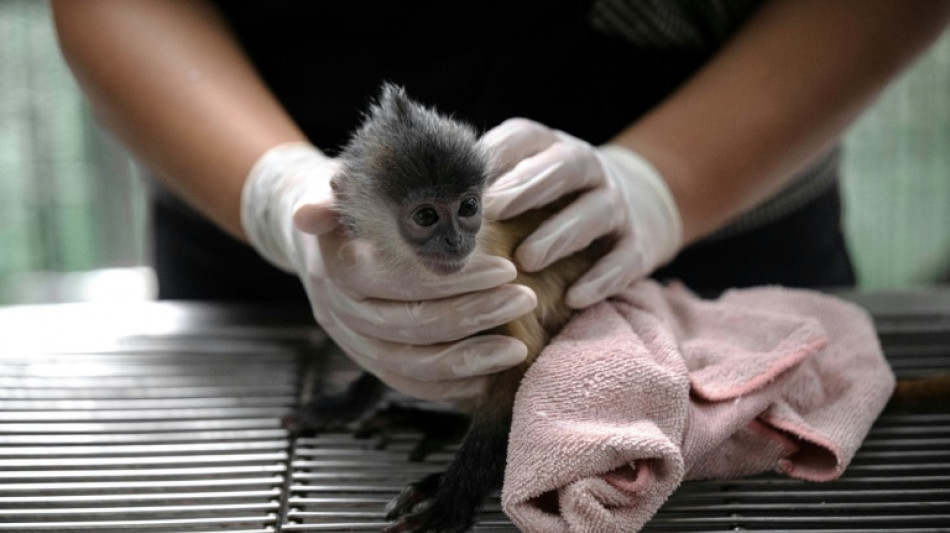
Online and undercover: saving trafficked wildlife in Thailand / Photo: Lillian SUWANRUMPHA - AFP
Nawee Changpirom has spent years working to rescue trafficked wildlife in Thailand, but even he can sometimes hardly believe the creatures he has found: leopards, hornbills, and once an anteater.
"We even found living corals hidden in a ceiling," he told AFP.
Nawee heads a raid unit in the Department of National Parks, Wildlife and Plant Conservation (DNP) that tries to stop the sale of everything from African elephant ivory to monkeys wanted as pets or for laboratory testing.
Alongside weapons, drugs and human trafficking, the illegal wildlife trade is among the most widespread and profitable forms of organised crime globally, run by cross-border cartels.
Thailand occupies a rareposition because of its abundant local wildlife, the availability of rare species in nearby countries, and its accessibility by sea, air and land.
The DNP set up a dedicated Wildlife Crime Intelligence Unit (WCU)in 2023 with three permanent staff charged with tracking and intercepting illegal purchases.
They spend much of their time trawling social media, which is now "the key channel" for buying and selling illegal animals, said WCU director Polawee Buchakiet.
Wildlife traders often describe animals as needing to be "rehomed", rather than explicitly offering them for sale, and post tightly cropped images of their wares to avoid revealing their locations.
But the WCU has undercover officers who can track them down.
- Undercover officers -
One undercover officer known by the pseudonym "Tee" has shinned up electricity poles disguised as a repairman to peer into courtyards and take photos, and posed as a land surveyor to look into windows on neighbouring plots.
The WCU needs such evidence to obtain court warrants to go in and seize the animals.
He is still haunted by cases where sellers could not be located, or the team arrived too late, finding the creatures either dead or so sickly they died soon after rescue.
Trafficked animals are often weakened by the process of smuggling, stressed by the loss of their habitat and family group, and vulnerable to unfamiliar diseases.
"I wonder to myself if we could have done something to get there sooner," Tee, 43, told AFP.
"Whether they are big or small, all animals' lives are precious."
- Exotic pets -
At just six months old, the leaf monkey curled up inside DNP vet Thanawadee Phaichana's rubber-gloved hand is very small indeed.
He was intercepted in luggage at Bangkok's Suvarnabhumi Airport, bound for India, where demand for exotic animals as pets has been growing.
A second monkey found in the same bag died after being rescued.
"Most of these smuggled animals will be in a weak condition... some are given sedatives or even mild anesthetic to keep them from moving or making noise," Thanawadee said.
Animals rescued in and around Bangkok often come to the DNP's small facility for initial treatment before being transferred to a sanctuary.
Older, healthier animals might eventually return to the wild, but younger ones struggle to learn the skills needed to survive.
"I feel sorry for them," said Thanawadee.
Wildlife traffickers can face up to 10 years in prison for crimes involving protected species, or 15 years for endangered species.
There has been a string of recent high-profile arrests, including a July raid that rescued a leaf monkey, a gibbon and hundreds of turtles, as well as multiple interceptions at airports.
But there have also been setbacks.
In 2019, a Thai court dismissed the case against suspected wildlife trafficking kingpin Boonchai Bach. While the Supreme Court later sentenced him to prison, he remains at large.
The team also struggles with stonewalling from social media sites and chronic shortages of staff and funds.
Officers posing as undercover buyers sometimes have to use their own money, Nawee said.
What would make a real difference? An end to the exotic pet trade, he said.
"These are wild animals, they don't belong in a cage."
G.Karamanlis--AN-GR