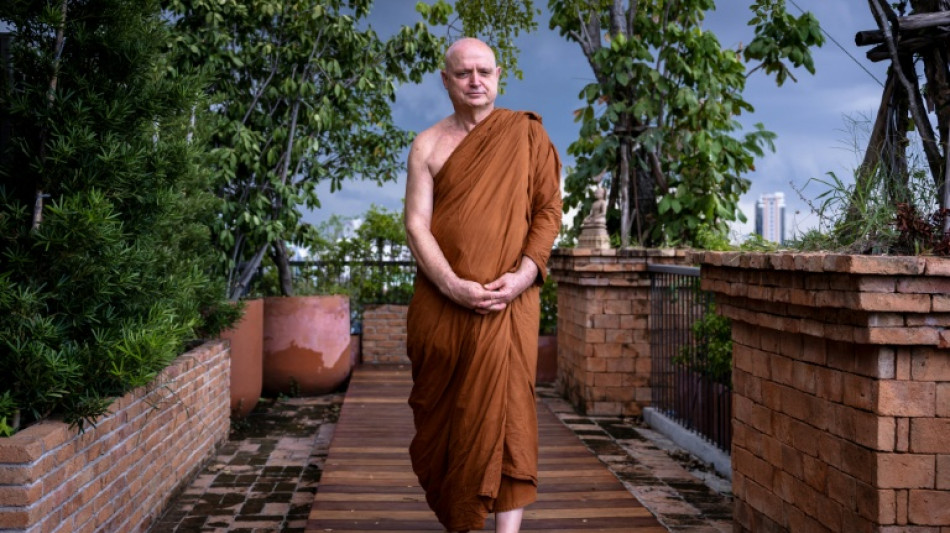
'Left-field' life: Briton becomes Thailand's top foreign monk / Photo: Chanakarn LAOSARAKHAM - AFP
From a working-class childhood on the southern English coast to the top foreign-born monk in Thailand, Shaun Chiverton's quest for a better life has taken him further than most.
Five decades after he travelled to India to follow the Buddha's teachings, the 68-year-old this summer became the first non-Thai to be elevated to the rank of Somdet Phra Rachakhana, or royal monastic leader -- the second-highest level in Thailand's monkhood.
"My father said, 'Well, we always knew he'd do something weird, we just didn't know what kind of weird it would be'," the monk, now known as Ajahn (Teacher) Jayasaro, told AFP with a smile.
But he understood: "My dad said, 'Look, I just want you to be happy'."
He grew up in a secular family on the Isle of Wight, a bookish child in a small town who from his teens was driven by some big questions.
"One was, what's the best way to live your life as a human being?" Jayasaro said in a recent interview at a retreat centre near Bangkok.
"And second, given that there's so much suffering and injustice and violence in the world, could the world be better than it is?"
Jayasaro became interested in Buddhism and set off for India, travelling around the region before settling in Thailand, where he became a monk.
After previously feeling like "a kind of freak", he said he arrived at a monastery in northeast Thailand to find "everybody more or less shares the same views and aspirations -- it's just wonderful".
- 'Completely unqualified' -
Jayasaro joined the forest monks of Theravada Buddhism, who lead an austere life of discipline, renunciation and meditation, and has spent much of the past two decades in a hermitage near the Khao Yai mountains.
He has written several books in English and Thai, and holds regular retreats. His YouTube channel has 100,000 subscribers.
He was granted Thai citizenship by royal decree in 2020 and has received numerous royal promotions, culminating in his latest elevation which made him one of just 18 at that rank.
"In many ways I'm completely unqualified," he said, comparing his "completely left-field" forest life to other senior monks who lead top monasteries.
But his background gives him particular insight, he noted.
"I have a broader knowledge in terms of relating traditional Buddhist teachings to the changing world that we live in," he said.
He supports the broad ban on female ordinations in Thai Buddhism, but said there should be a way to accommodate women who wanted to study and practice.
"There are women with a genuine spiritual vocation and we need to be able to provide a vehicle and a way for them to live a life," he said.
Jayasaro's teachings emphasise the importance of living a good life and letting go of material things and negative habits to develop more "noble" qualities, such as kindness and compassion.
Not all Buddhists adhere to this, and Jayasaro acknowledged "a certain amount of corruption" even within the monkhood, after a series of sex and fraud scandals.
- Old age and death -
The Buddha lived around 2,500 years ago, but Jayasaro said his teachings offer "timeless" tools to manage the challenges of modern life.
"People are really stressed out these days. There's an epidemic of depression and anxiety. But these are not new mental states... and there are ways of dealing with them," he said.
He lamented the rise of "almost manic individualism", which he linked to mental health issues, particularly among young people.
"Saying that 'you can be whatever you want to be' is just really unfair on children," he said.
"A lot of people wake up when they're in their 30s or 40s and realise, no, they're not going to be what they want to be.
"And then where do you go from there?"
The same question can be asked of Jayasaro.
"The classic Buddhist answer would be old age, sickness and death, I think, a very blunt answer," he said with a laugh.
In fact, his next step is writing a TV series in English for YouTube, focused on an "everyman" figure in the time of the Buddha.
He hopes it will help others benefit from the teachings that have shaped him.
"I just feel an incredibly fortunate human being to have been able to live the life I have," he said. "I just have a happy life."
Z.Papadakis--AN-GR