Desire Under the Elms review - a horror show that bruises more than it moves
Ebenezer Bamgboye’s production of Eugene O’Neill’s Desire Under the Elms at London’s Almeida Theatre radically reimagines the classic drama through a horror lens. By shifting the setting to the American South and incorporating live music and experimental movement, the director creates a visceral experience that critics find striking yet emotionally exhausting.
Ebenezer Bamgboye’s production of Eugene O’Neill’s Desire Under the Elms at London’s Almeida Theatre radically reimagines the classic drama through a horror lens. By shifting the setting to the American South and incorporating live music and experimental movement, the director creates a visceral experience that critics find striking yet emotionally exhausting.
The 1924 play, which was banned in the UK for 16 years due to its themes of rural greed, sexual manipulation, incest, and infanticide, draws roots from Greek dramas such as Phaedra and Medea. Bamgboye’s direction alters the source material so significantly that it becomes almost unrecognizable, a choice that yields mixed results.
The production moves the narrative from 1850s rural New England to the early 1900s in the deep South. This shift is accompanied by the addition of actors of color as musicians and dancing hoodoo spirits, introducing a new perspective on ownership. Casting Eben, the stepson, as a Black man reframes his father’s harsh farm management as that of a plantation owner. However, this reinterpretation tests the audience's suspension of disbelief; it renders the central question regarding the paternity of Abbie’s ill-fated baby—whether the child belongs to Eben or her husband Ephraim—less coherent.
Musical elements are woven throughout to vary O’Neill’s incessant monologues. Choolwe Laina Muntanga plays a restless spirit, representing the farm’s former mistress. Seated on stage during the pre-show in a faded grey frock, she gazes at the audience before delivering a haunting rendition of 'The House of the Rising Sun'. Her soulful songs provide heartrending moments amidst the tension.
Tendai Humphrey Sitima on guitar and Nathaniel Wade on trumpet emerge from the shadows of Basia Bińkowska’s minimal polished-wood set. Reflective floors allow ripples of light to play across the musicians as they inform and puppeteer the action through sound. Their costumes gradually become more undead-like as they leap on and off stage, playing extra characters or harassing the named roles.
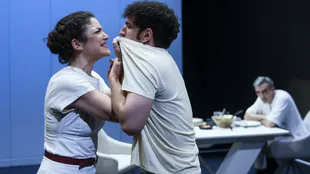
Rose Ryan’s movement and intimacy work features characters colliding in heightened, experimental dances more suited to Sadler’s Wells than the Almeida. While initially jarring, the choreography breaks up the dialogue-heavy script. Kelly Gough’s portrayal of Abbie is described as a stalking, demonic interpretation. Dressed like a crow, she winds her arms unnaturally, snarling and grimacing in frightful expressions.
Abbie’s intrusion into the unhappy farm life of her new husband, Ephraim (played by Antony Byrne), and her resentful yet alluring stepson Eben (Zackary Momoh) sets the three on a path toward inevitable misery. The production tips heavily toward horror and the grotesque, at times obscuring the poetic dialogue. The collision of poisonous individuals reaches such a cartoonish extreme that empathy becomes difficult. In one striking image, Abbie leans over a light shining from her child’s cot, screaming "MAA FARMMM," appearing barely human.
The review concludes that while the production is bold and occasionally striking, it leaves the audience emotionally bruised by its end. Desire Under the Elms runs until 23 December at the Almeida Theatre, London, N1 1TA.
For more information, visit almeida.co.uk.
N.Tsakalidis--AN-GR