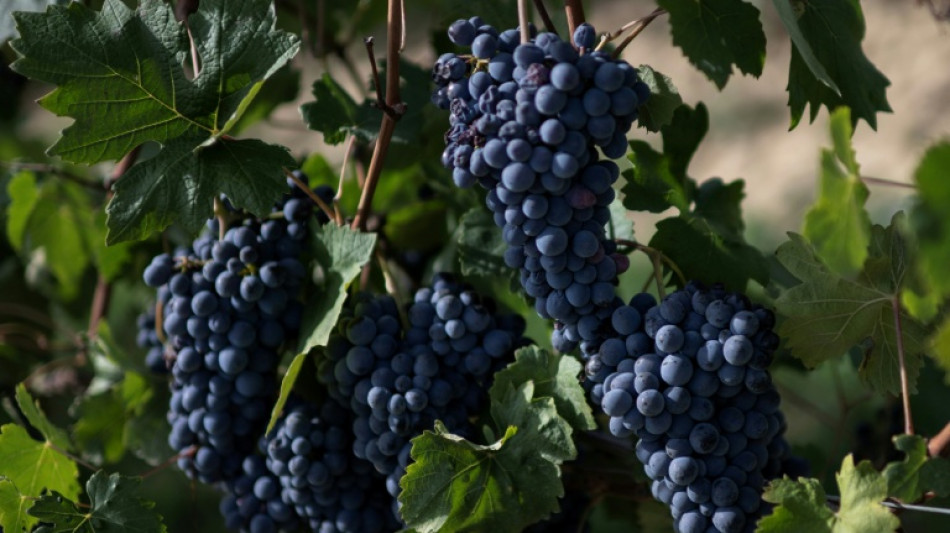
Italy winemakers hail bumper harvest but cut output / Photo: Marco Bertorello - AFP
Wine growers in Italy's Piedmont region are celebrating a bountiful harvest despite the extreme heat but warn they have to cut production because of trade headwinds and changing consumer habits.
In Agliano Terme, where vine-covered hills stretch as far as the eye can see, a dozen farm workers were picking the last Barbera grapes -- a variety behind one of the region's most popular red wines.
"We started harvesting at the end of July, which is unheard of," said Filippo Mobrici, 59, head of the Barbera d'Asti Consortium.
"But I've never seen such a beautiful vintage, both in terms of quantity and quality. It's a five-star harvest," the winemaker said.
The summer of 2026 was the hottest ever recorded in this northern Italian region between the Alps and the Po Valley, with an average temperature of 21.6 degrees Celsius and peaks of 40 near Agliano Terme.
But the winter had been rainy, and the beginning of spring as well.
"The vines were able to build up sufficient water reserves so that, despite the extreme heat of recent months, the grapes reached maturity in good conditions," Mobrici said.
Winemakers also protected the grapes from the sun by keeping more foliage on than usual.
But, like many Italian regions, Piedmont has produced too much wine in recent years and growers are struggling to sell it in markets disrupted by wars, US tariffs, and younger generations which drink a bit less.
As a result, Barbera d'Asti producers have decided to limit volumes of the variety collected this year from nine tonnes to 8.5 tonnes per hectare.
- 'Bold choices' -
Producers are also putting less wine on the market.
Stocks in Italy, the world's leading wine-producing country, were up 6.9 percent year-on-year in July, according to official data.
The stored volume reached the equivalent of more than 5.6 billion bottles, nearly one year of production.
In Piedmont, some winegrowers have chosen to turn part of their production into vinegar this year.
Italy's Wine Union (UIV) is calling for production to be planned according to the market and for no new vineyard plantings.
UIV president Lamberto Frescobaldi, a 33rd-generation Tuscan winegrower, said he was also open to the idea of removing old or unviable grapevines.
"It's time to take responsibility for making bold choices, even unpopular ones," he said earlier this year.
In Agliano Terme, Filippo Mobrici refuses to consider the idea of uprooting vines.
"For us, vineyards are not just a production tool," he said.
"They are an expression of our culture and a key element in shaping and preserving the land. We do not want to uproot ourselves."
A few kilometres further south, in San Marzano Oliveto, 41-year-old Luca Garberoglio is also pleased with a fine harvest and insists that stocks are "manageable" at the scale of the small Barbera d'Asti area.
Like many neighbouring producers, his family estate Carussin has succeeded in moving upmarket thanks to the production of organic wines exported in particular to Scandinavia.
And, because of climate change, the taste is changing.
Barbera d'Asti, "traditionally dominated by notes of cherry and plum, is increasingly evolving toward more concentrated aromas of blackberry and blackcurrant", Garberoglio said after a tasting.
K.Lykoudis--AN-GR