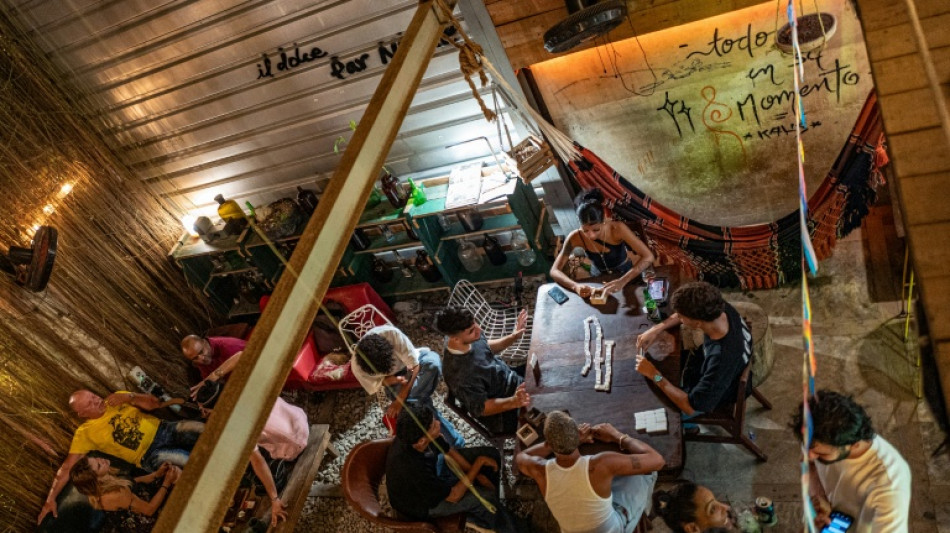
No lights, no friends: Cuban youth grapple with loneliness / Photo: ADALBERTO ROQUE - AFP
With frequent power cuts transforming Havana into a ghost town, young Cubans are struggling to get their kicks, many resorting to games of dominoes with strangers to pass the time.
Most of 24-year-old Melanie Tejeda's friends have left the US-blockaded island nation, and only five of the 43 students who started an acting program with her two years ago remain.
She has started going alone to a bar called El Bujeco, where she chats with other dispirited youths looking to escape the blackouts in one of the few places with a generator adapted to run on natural gas.
"Those friends are gone," Tejeda told AFP, explaining that many now live in Miami, Madrid or elsewhere.
They use social media to keep in touch when the internet connection and time difference allow, but a sense of isolation one day pushed Tejeda to sit down with a group of strangers huddled around a game of dominoes.
"Dominoes is one of the cultural traditions that has endured, that still exists, and that keeps us united," she said.
Bar manager Yadier Delgado, 24, calls El Bujeco "a refuge for all the young people who still don't know what to do with themselves."
"There aren't many options. Almost all of these places haven't been able to stay open under these circumstances," said Delgado.
Not even leisure has been spared by the US energy blockade imposed on Cuba in January, which has plunged the island into a seemingly endless crisis.
- 'I'm leaving' -
On the second floor, 22-year-old Sian Dimitri Felipe and a friend battle it out over a video game.
Felipe taught himself how to program as a teenager and is developing his own game, although he acknowledges that working in Cuba throws up constant obstacles.
"Programming without electricity or an internet connection is a problem... you can either come here to play or stay behind during a blackout, get bitten by mosquitoes, and catch dengue," he said.
He belongs to a generation too young to have experienced the vibrant cultural scene that teemed in Havana for decades.
Many of the theaters, cinemas and concert halls that once pumped life into the capital have shuttered or drastically reduced their offerings.
Felipe recalls that until very recently, "there was a sense of community" among young people.
But that "no longer exists," he said, adding that he misses sitting outside with his friends at night -- an activity now considered dangerous due to prolonged power cuts and heightened insecurity.
The young adult doesn't see a future for himself at home.
"I'm leaving... Every young person in this country wants to leave."
- No money -
Felipe earns some money programming for clients in Miami while Tejeda works at children's parties to scrape some cash, but most young people have not escaped the pangs of Cuba's economic crisis.
"It's not really possible to go out much. The little money you make has to go toward other things," said content creator Yurisladys Mora, 23, as she left a nightclub in Old Havana.
Nights out have been rare for Mora in recent months after spending a huge chunk of her income to buy black-market medicine for injuries she sustained in a motorbike accident.
With little money at their disposal, the streets make for the ultimate hangout spot, and every weekend, young people turn out to dance and rollerblade all along Havana's Paseo del Prado.
Israel Quiala, who travels 20 kilometers (12 miles) from the San Miguel del Padron neighborhood armed with nothing but a portable speaker, rehearses dance routines for hours on end in the city center.
The crisis is tough for adults, the 17-year-old believes, but "they at least experienced... a good time in Cuba."
"Being young now is harder," said Quiala, who dropped out of high school to pursue urban dance.
V.Tsitsipas--AN-GR