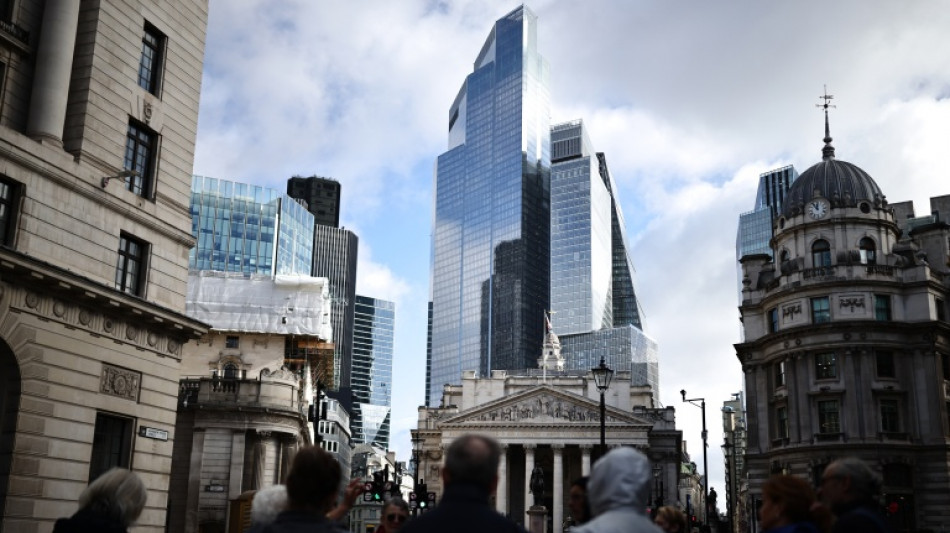
Rising UK inflation, debt knocks govt ahead of budget / Photo: Henry NICHOLLS - AFP
UK inflation and public borrowing rose more than expected in September, official data showed Wednesday, heaping pressure on the country's Labour government ahead of its annual budget due next week.
Finance minister John Healey delivers the first budget of Prime Minister Andy Burnham's administration on October 28, also against a backdrop of rising borrowing costs for the government, businesses and individuals.
"We know that price rises from conflicts in the Middle East and Europe are hitting Britain and countries worldwide," Healey said Wednesday in reaction to the latest economic data as he referred also to energy prices jumping on the Russia-Ukraine war.
Healey, whose official title is chancellor of the exchequer, added that his maiden budget would see the government "maintaining fiscal discipline.. while giving businesses and families some breathing space".
The Office for National Statistics said Britain's Consumer Prices Index jumped to 3.5 percent in September from an annual rate of 3.1 percent in August.
The September reading was the highest in almost a year, the ONS said, and surpassed analysts' consensus forecast of 3.4 percent.
"Transport, particularly motor fuels, made the largest upward contribution to the... change," the ONS noted in a statement.
The cost of diesel at UK pumps recently reached the highest level since July 2022, shortly after Russia launched its invasion of Ukraine.
ONS chief economist Grant Fitzner also noted Wednesday that in September, "the annual cost of both raw materials and goods leaving (UK) factories continued to rise, driven by higher crude oil and petrol prices".
- £3 trillion debt -
Separate official data Wednesday showed the government's net borrowing reached £24.5 billion ($32.8 billion) in September, beating market expectations of about £24 billion.
"Spending, including higher debt interest costs, increased more than government income, partly reflecting the impacts of inflation," the ONS said.
Governments around the world are seeing the yields on their bonds jump to multi-decade highs as wider inflation climbs.
This is causing central banks to hike their own benchmark rates, heaping pressure on businesses and individuals holding loans, including mortgages.
Following Wednesday's data, analysts increasingly predicted that the Bank of England would raise borrowing costs at its next regular policy meeting in November.
"The key question from here is whether higher rates can contain inflation without putting further pressure on an economy (in the UK) that is already navigating a difficult growth backdrop," said Richard Flax, chief investment officer at Moneyfarm.
The ONS revealed also that UK public debt at the end of September was provisionally estimated to have exceeded £3 trillion for the first time.
However, debt as a proportion of gross domestic product decreased by 0.7 percentage points to 94 percent.
Richard Carter, head of fixed interest research at Quilter Cheviot, said the debt numbers "illustrate the difficult circle the government is attempting to square.
"It wants to pursue an ambitious long-term spending programme while borrowing costs and existing debt are already placing significant demands on the public finances."
Q.Papadatos--AN-GR