Ebola spreading into new areas in northeast DR Congo: WHO / Photo: Benediction MURHABAZI - AFP
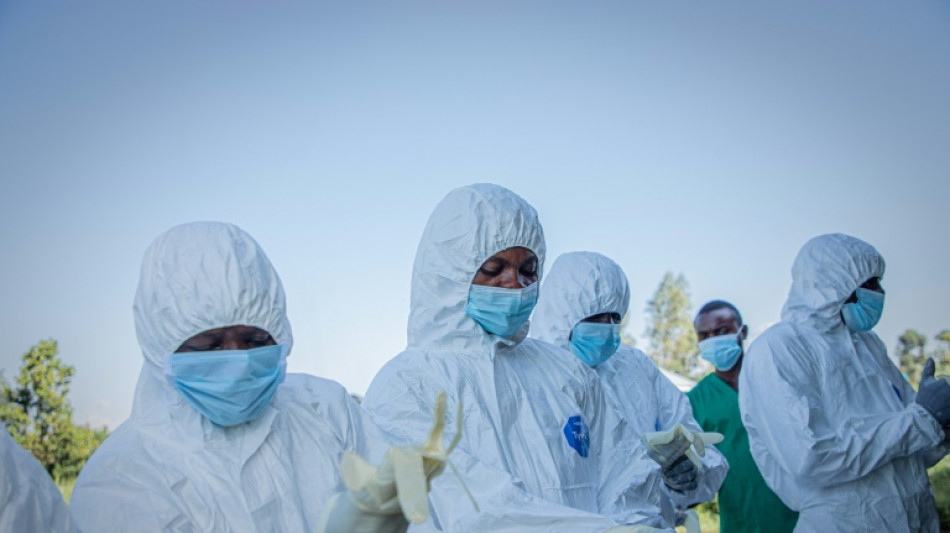
The Ebola outbreak is spreading into new areas of the northeastern Democratic Republic of Congo and is bigger in scale than hitherto detected, the World Health Organization warned Friday.
Much more needs to be done to contain the virus, the WHO said, with isolation bed capacity far below the anticipated need, based on how it is spreading.
Since the outbreak was declared on May 15, there have been 676 confirmed Ebola cases, including 136 deaths in the DRC, according to the latest figures from the WHO.
There are a further 119 suspected cases, while 32 patients have recovered.
No approved vaccines or treatments exist for the rare Bundibugyo species of the virus responsible for the current outbreak, which is centred on Ituri province, with cases also detected in North Kivu and South Kivu provinces.
"The outbreak continues to expand both in terms of case numbers but also in terms of geographic spread," said Olivier le Polain, the WHO's head of epidemiology and analytics for response.
- Contact tracing -
Speaking from Beni in North Kivu, he said that cases were being identified in new health zones within the three affected provinces on an almost daily basis.
"That reflects really the scale of this outbreak: a scale that is much bigger than what is being detected, and the high mobility of the population," he told reporters in Geneva.
Le Polain said that while in recent weeks, cases in new areas could be traced back to travel from hotspots, now "we also see local community spread in new areas".
"There are still many blind spots in some areas that are high risk," he added.
Le Polain said contact tracing remained below ideal levels, with just over 70 percent of contacts being appropriately traced.
"That's a huge improvement from where we were about a week or two ago, but it's still too low to ensure appropriate control," he said.
"Surveillance can scale up, but if you don't have any space to put your patients safely, it becomes very difficult," he added.
He said that "compared to where the epidemiology is heading", the current capacity of 250 isolation beds across the affected provinces would not be enough and needed scaling up "quite rapidly".
- Expected impact on children -
The UN children's agency UNICEF warned of a likely rise in cases amongst children via household transmission in the coming weeks.
After returning from Ituri's capital Bunia, Douglas Noble, UNICEF's global incident manager for Ebola, said that in the province, more than half of children aged under five are chronically malnourished.
"The point is: these are already very vulnerable children," he told reporters.
"As the outbreak evolves we must be prepared for increasing household transmission, which means we may see more children affected in the days ahead," based on previous Ebola crises.
"We are expecting it, and we are taking steps in our interventions... to respond to that," he told reporters.
The outbreak has also spread across the border into Uganda, which has recorded 19 confirmed cases, including two deaths.
The African Union's health agency said Thursday that the situation in Uganda was "under control".
The WHO classifies the Ebola risk as very high within the DRC; high for Uganda; high for countries sharing land borders with the DRC and Uganda; and low elsewhere.
Y.Papantoniou--AN-GR