'Catastrophic': Swiss glaciers lose fifth of mass in five years / Photo: Fabrice COFFRINI - AFP
Switzerland's glaciers, which are disproportionately impacted by climate change, have lost nearly 20 percent of their mass in five years, experts said Thursday, with 2026 registering the second-biggest melt on record.
Swiss glaciers saw 5.5 percent of their volume melt away this year, the Glacier Monitoring in Switzerland (GLAMOS) network found in a new study, published after a record hot summer preceded by a winter with little snowfall.
"The glaciers this year have lost enormous quantities of ice," said GLAMOS chief Matthias Huss, describing 2026 as "a catastrophic year".
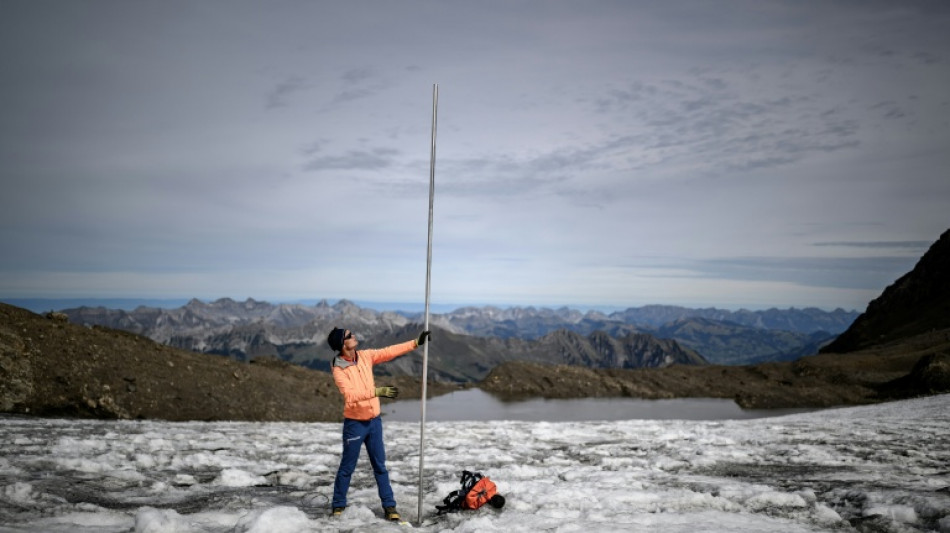
Perched on the Scex Rouge glacier, at an altitude of nearly 3,000 metres, he gazed across the landscape in despair.
"This is a glacier that isn't surviving," he said.
"There will be probably no ice in 10 or maybe 15 years."
He carefully dismantled the four-metre-long aluminium measurement stake inserted at the centre of the glacier.
In late July, when it was installed, it was completely embedded, but now more than three metres protrude from the grey surface of the ice.
"It's not that we are surprised, because we know how fast the glaciers are melting," Huss said.
"But to see the colours of the mountains where there is no snow left, there is just these rocks and these dark glaciers that are a relic from the past... it's just incredible."
Between 2022 and 2026, the melt rate at Switzerland's glaciers was "more than twice as high as in any previously monitored five-year period", the GLAMOS report said, noting an ice volume loss of almost 20 percent since 2021.
While Switzerland's glaciers have long been shrinking, the melt has recently sped up dramatically.
While 10 percent of Swiss ice volume disappeared between 1990 and 2000, 27 percent was lost in the past 10 years, the report showed.
GLAMOS based its findings on extensive measurements at 23 reference glaciers in September, which it extrapolated to the nearly 1,300 glacial formations still found in Switzerland.
- 'No chance of surviving' -
The report comes after a summer where the months of June, July and August were each the hottest ever recorded in Switzerland since measurements began in 1864, according to the Swiss Federal Office of Meteorology and Climatology.
This year, the protective snow cover on the glaciers had already partially disappeared during the June heatwaves, and had completely disappeared by September, even at high altitudes, GLAMOS said.
"Alpine glaciers have no chance of surviving in the long term under such conditions," GLAMOS said in a statement.
Due to significant melting this year, the researchers even had to reposition measurement stakes -- including on the highest-altitude glaciers -- further up after the ice melted away in the original locations.
The average ice thickness of some glaciers decreased by 2.5 to 4.0 metres, while the more exposed glacier tongues saw losses of up to 10 metres of thickness over the summer.
- Rhone and Aletsch Glaciers -
Although temperatures were higher this year, the ice loss did not surpass the record set in 2022, since many glaciers saw more snow before the summer melt than they had four years ago.
Less dust from the Sahara Desert also settled on the glaciers this year, allowing more sunlight to be reflected back into the atmosphere rather than being absorbed by the snow.
There were exceptions, however.
Four major glaciers experienced record melting this year, including the iconic Rhone Glacier and the Aletsch -- the biggest glacier in the Alps.
As the glaciers retreat, concern is meanwhile growing over the future availability of water resources.
Between July and September this year, the glaciers lost a total of around 2.2 trillion litres of water.
Huss said that quantity was "difficult to imagine".
"It's more than four times the annual freshwater consumption of Swiss households," he pointed out.
O.Karatzas--AN-GR