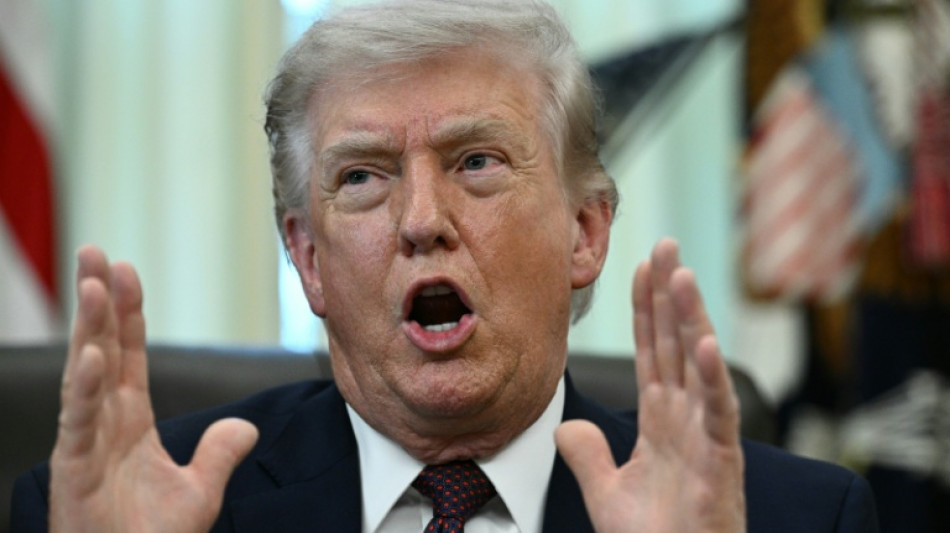
Israel strikes Iran's capital as Trump set to address US on war / Photo: Brendan SMIALOWSKI - AFP
Israel struck Iran's capital on Wednesday ahead of US President Donald Trump's planned address to the American public on the month-long war he said could end within weeks.
The conflict that began on February 28 with US-Israeli attacks on Iran has mushroomed throughout the region, sending energy markets into a tailspin and threatening to torpedo the global economy.
With the official status of talks to resolve the conflict uncertain, Iranian state television reported "attacks on Tehran" and explosions heard in the capital's north, east and centre early Wednesday.
The Israeli military confirmed it had carried out a "wide-scale wave of strikes" on Tehran and later said it was intercepting a new missile attack from Iran, the first in around 20 hours.
Trump, whose statements on the war have swung from combative to conciliatory, had earlier said the war could be over in "two weeks, maybe three".
"But we're finishing the job," he insisted.
The White House said he would give "an important update on Iran" to the nation at 9:00 pm Wednesday (0100 GMT Thursday).
His Iranian counterpart Masoud Pezeshkian meanwhile assured that the Islamic republic had the "necessary will" to end the war, provided its enemies guaranteed it would not flare up again.
The comments came as Iran's Revolutionary Guards threatened major US tech firms from Wednesday if more Iranian leaders were killed in "targeted assassinations".
The Guards said that 18 companies, including Intel, Tesla and Palantir, were complicit in previous killings and warned they should expect "destruction" if there were any further deaths.
But Israeli Prime Minister Benjamin Netanyahu said the campaign would go on, even after insisting the conflict had "changed the face of the Middle East" and eradicated Iran's ballistic and nuclear threats.
"We had to act, and we acted," he said in a televised statement on the eve of the Passover holidays. "We will continue to crush the terror regime."
Israel said on Wednesday its air defences were responding to a missile fired from Yemen, which Israeli media said was intercepted with no reports of casualties.
Yemen's Houthi rebels joined the war over the weekend, firing missiles at Israel, and have threatened Red Sea shipping, which would further hamper trade already constrained by Iran largely shuttering the Strait of Hormuz.
- Tanker hit -
On another front, Lebanon's health ministry said early Wednesday that seven people were killed in Israeli strikes in south Beirut and a nearby area, while the Israeli military said it had struck a senior Hezbollah commander.
Israel's campaign against Iran-backed Hezbollah has left more than 1,200 dead in Lebanon, according to the health ministry, with over a million displaced.
The Israeli military said Wednesday it had struck "approximately 7,000 targets" since the start of the war, including "4,000 terrorist targets" in Iran.
More than 2,000 Iranian soldiers and commanders were "eliminated" in the strikes, it said.
Iran has kept up retaliatory attacks on Gulf nations it accuses as serving as a launchpad for US strikes and has threatened to target vital infrastructure across the region, including energy sites.
Kuwait's civil aviation authority said Wednesday that the Gulf state's international airport had come under an Iranian drone attack that led to "a large fire" at its fuel tanks.
Bahrain's interior ministry said a fire broke out at a business facility "as a result of the Iranian aggression".
Saudi Arabia's defence ministry said several drones were "intercepted and destroyed".
A tanker was hit by a projectile in the Gulf, off the coast of Qatar's capital Doha, a British maritime security agency said, reporting some damage but no casualties.
- 'Nothing they can do' -
Pentagon chief Pete Hegseth, speaking to reporters early Tuesday after he visited US troops in the Middle East, vowed that "the upcoming days will be decisive."
"Iran knows that, and there's almost nothing they can militarily do about it."
US Central Command shared a video late Tuesday it said showed forces dropping "precision munitions on underground military targets deep inside Iran".
Trump had threatened on Monday that if Iran didn't agree to a deal, US forces would "obliterate" its oil wells, its main Kharg Island export terminal, and possibly water desalination plants.
The United States has not said who it is speaking with in Iran, which has denied it is in talks.
Iranian Foreign Minister Abbas Araghchi told Al Jazeera that he still receives messages from US envoy Steve Witkoff, "directly, as before, and this does not mean that we are in negotiations."
Crude prices jumped on lingering worries about Iran's closure of the strategic Hormuz strait, even as Asian stocks rallied on the back of Trump's comments about the war possibly ending soon.
Japan's Nikkei climbed more than three percent at the open Wednesday and South Korea's Kospi was up nearly five percent.
Trump said France, China and other countries that seek passage through the Strait of Hormuz will have to "fend for themselves," lashing out at allies that have refused to help Washington secure the waterway while fighting takes place.
Rising fuel prices in the US stoked by the standoff have become a headache for Trump.
At a gas station in Washington's suburbs, Jeanne Williams, 83, was aghast at more costly prices visible on an LED board.
"That is horrible," she said.
"I'm just bewildered, confused, unhappy. Because we didn't ask for the war."
But the US leader said he was not worried about spiking prices hurting American wallets.
"All I have to do is leave Iran," he told reporters.
"And we'll be doing that very soon, and they'll come tumbling down."
burs-jfx/ceg
K.Papadimitriou--AN-GR