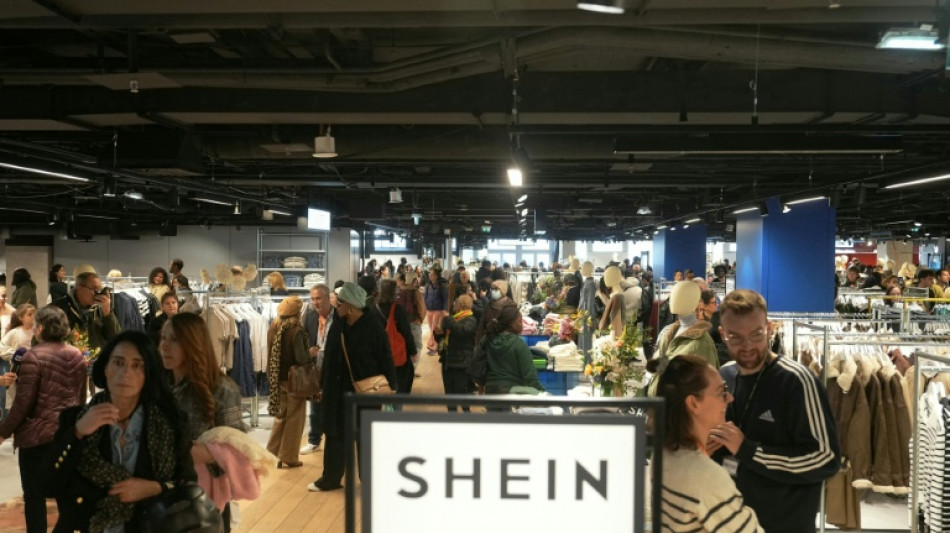
Shein grapples with EU backlash, but clients keep coming / Photo: Dimitar DILKOFF - AFP
Shein's meteoric growth has made it a lightning rod for critics of ultrafast fashion in Europe, where officials are trying to rein in its operations in the name of social and environmental responsibility.
The probes, financial penalties and fierce debates have dampened but not fully curbed the enthusiasm of millions of clients in a key market for the China-founded online juggernaut.
The company's $1.7 billion stock market listing, announced on Monday, aims in particular to juice its international expansion.
- Short-lived Paris store -
Starting in 2012, Shein began online sales of its continually renewed stock of tops, dresses and other items, drastically undercutting the prices of its rivals -- to say nothing of traditional clothing stores.
Its European customer base rose to 156 million average monthly users by the end of last year, making Shein one of the continent's biggest e-commerce platforms alongside China's AliExpress (193 million users), and Amazon (around 180 million).
In November, the group made waves with its first-ever physical outlet, a dedicated space in the storied BHV department store in Paris.
Hundreds of customers lined up on its opening day, and dozens more people gathered to protest, requiring a heavy police presence to keep the tense situation from getting out of hand.
Demonstrators slammed what they called inhumane working conditions at Shein's suppliers, the environmental costs of selling clothes not made to last, and unfair competition against brick-and-mortar retailers struggling to stay open.
The company says it holds its suppliers to strict compliance standards and does not tolerate forced labour.
- Sex doll scandal -
It did not help that just a few days before the Paris opening, France's consumer protection agency said it had discovered childlike sex dolls for sale on Shein's platform.
Accusing the company of fostering child pornography, French officials asked the European Commission to open an inquiry under the bloc's wide-reaching Digital Services Act.
The EU investigation that opened in February 2026 targeted the sale of illicit goods "including child sexual abuse material" as well as what it alleged was Shein's "addictive design".
In June, French authorities imposed two fines on Shein totalling more than 22 million euros ($25 million), citing problems with product traceability, environmental labelling and delivery times.
The next month it secured an EU-wide halt on the sales of items with crocodile logos -- deemed a counterfeit of France's famed Lacoste brand of polo shirts.
Overall, Shein has paid over 210 million euros in various French fines over the years, and Italy has also imposed fines alleging misleading environmental claims.
In June, the BHV's new owners said they would part ways with Shein, calling the decision to welcome a physical outlet a "strategic error".
- Regulatory pushback -
Shein has called the penalties "disproportionate and discriminatory", while China's commerce ministry says they violate World Trade Organization rules.
That did not stop the European Union from imposing duties on the billions of small, inexpensive retail parcels entering the bloc each year -- most of them from Chinese e-commerce sites.
Since July, a duty of three euros per item applies to packages valued at less than 150 euros, similar to a move last year by US President Donald Trump's administration against products originating in China.
But the EU fee applies to the type of item imported, not the number. So a person buying five T-shirts pays just three euros, but someone buying a T-shirt, jeans and socks would pay nine euros.
Brussels says the duty helps compensate for overwhelmed customs authorities given the popularity of e-commerce, in particular for clothes and other items from China and elsewhere that do not comply with EU standards.
According to the head of the European Parliament's trade committee, Bernd Lange, the number of small parcels from abroad have more than quadrupled to 5.88 billion since 2022.
Starting in November, the EU will impose a still-undetermined handling fee on such parcels.
It is far from clear how effective the duties will be, especially as online giants like Shein could build warehouses in Europe to limit the impact.
After France imposed its own duty of two euros on such parcels this year -- before the EU system kicked in -- the customs office estimated it brought in around 2.3 million euros per month.
That was far below the 33 million euros per month the government had expected in the 2026 budget.
A.Fotiadis--AN-GR