Musk back in the spotlight, but politics dims the awe / Photo: Kent NISHIMURA - AFP/File
With a sports car that somersaults through the air, Elon Musk is back in the headlines for technological daring -- but his plunge into politics and his return to US President Donald Trump's side mean the world's richest man no longer enjoys the unqualified praise of years past.
"All the things that we were promised since the 1950s, of space travel and flying cars... he's doing all of those things," said Andrew Selepak, a social media professor at the University of Florida.
"And yet we're not giving it the attention, we're not giving it the awe that it probably truly deserves," he added.
In recent weeks, Musk has seemed to be everywhere at once.
On September 28, SpaceX's Starship megarocket reached orbit for the first time and deployed 26 Starlink satellites before splashing down in the Pacific -- a milestone for the rocket central to Musk's Mars ambitions.
Musk's central role in geopolitics has also been on display, with Ukraine complaining of disruptions to the Starshield satellite communications system its military relies on.
Even the platform formerly known as Twitter is enjoying something of a renaissance, with Musk's X now the go-to social media app for Silicon Valley insiders and the main marketplace for talk about artificial intelligence.
But despite his continued success, Musk's unrelenting commitment to right-wing politics has taken a toll.
No image captured that shift more than Musk brandishing a chainsaw on stage in February 2025 -- a gift from Argentine President Javier Milei -- as a symbol of his drive to slash the US government as head of the Department of Government Efficiency (DOGE) in the early months of Trump's second term.
Through DOGE, Musk's allies fanned out across federal agencies, driving cuts that effectively dismantled the US Agency for International Development (USAID) and contributed to a net loss of hundreds of thousands of jobs.
- 'National treasure' -
That combative imagery has been matched by Musk's posts on X, where hardline anti-immigration views and right-wing conspiracy theories sit alongside posts about rocket launches and Tesla robotaxis.
Now Musk is back in Trump's good graces, after a spectacular falling-out that followed his exit from DOGE in May 2025.
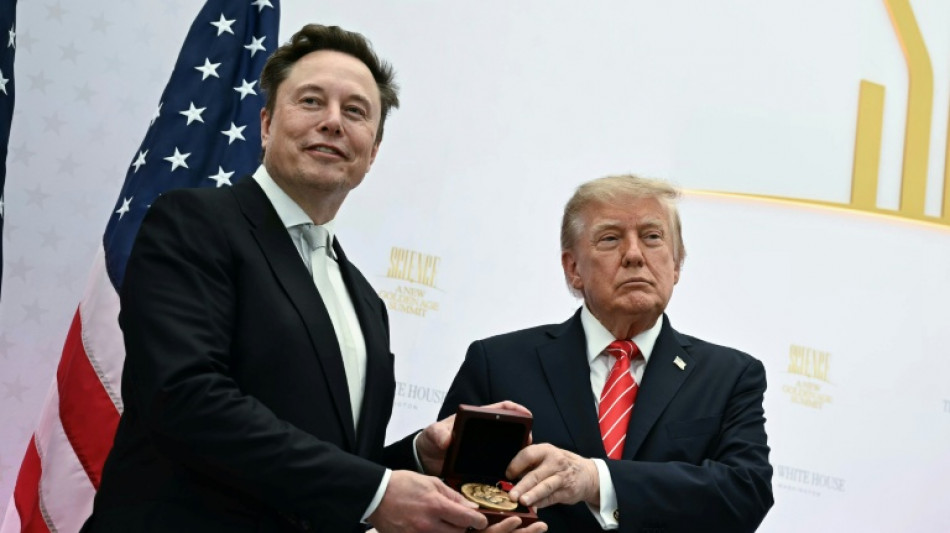
Last week, Trump presented Musk with the nation's top science medal, calling him a "national treasure" and "our modern-day Thomas Edison."
The renewed relationship comes as Musk has spent at least $276 million on Republican political campaigns ahead of next month’s midterm elections, in which the president's party is expected to struggle.
Of that, $158 million is funding a massive advertising campaign in Texas, Musk's home state, where the Republican candidate is trailing in the polls.
For left-leaning pundits, Musk is now increasingly seen as an agent of Trump and the tech billionaires rather than a technology savant working for the good of humanity.
That opposition plays out in "Musk," a four-hour documentary by Oscar-winning filmmaker Alex Gibney now in US theaters, which traces the life and career of the South Africa-born billionaire.
"I once described him as somebody who can jump off the edge of a cliff and invent a parachute on the way down. I think he thrives on chaos," Musk's first wife Justine Musk, who features prominently in the film, told podcaster Kara Swisher.
Yet, she added, "I always assume that there's a method to his madness," and many of his loudest actions may in fact be deflections and "sleight of hand."
The same may be true of Musk's dealings with Washington.
Few entrepreneurs depend as heavily on the federal government as Musk does.
SpaceX -- which went public in June in the largest initial public offering in history -- earns billions of dollars a year from NASA and Pentagon contracts, while Tesla's bet on robotaxis hinges on how quickly regulators allow driverless cars onto US roads.
Seen in that light, Musk's millions for Republicans may be less a political conversion than an investment.
B.Tsoukalis--AN-GR