Chennai’s YWTC Troupe Selected for Bharat Rang Mahotsav 2027
The Chennai-based YWTC Charitable Trust has been selected to present its inclusive theatre production, 'From Stone Age to Screen Age,' at the Bharat Rang Mahotsav 2027 in New Delhi. Founder Madhavi Latha Prathigudupu stated that the initiative aims to challenge industry misconceptions about performers with disabilities by providing professional training and accessible performance platforms.
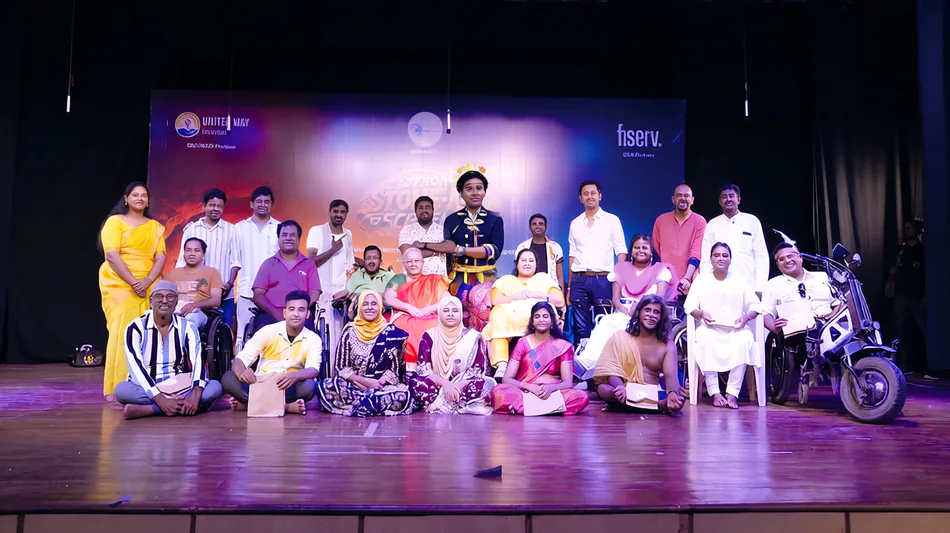
The Chennai-based YWTC (Yes, We Too Can) Charitable Trust has been selected to present its inclusive theatre production, 'From Stone Age to Screen Age,' at the Bharat Rang Mahotsav 2027 in New Delhi. The play, which blends humor, social reflection, and physical storytelling to trace the evolution of communication from the stone age to the age of artificial intelligence, will be staged by the troupe in February 2027.
The selection marks a significant milestone for the trust, founded by Madhavi Latha Prathigudupu. The announcement followed a curtain-raiser performance at Tapovan Hall of the Chinmaya Heritage Centre on Harrington Road in Chennai on November 24. The event featured performers with diverse disabilities, including visual, hearing, mobility-related, and neurodivergent conditions.
Prathigudupu explained that the trust’s focus on inclusive theatre originated from a concern regarding the near-total absence of persons with disabilities in mainstream media. "The participation of persons with disabilities in mainstream media was almost zero," she said. "We wanted to understand why this was happening and what was preventing them from entering these fields."
According to Prathigudupu, industry barriers include misconceptions that performers with disabilities cannot handle certain roles or that their presence lacks entertainment value. There are also concerns regarding the lack of training and exposure for such artists, alongside fears that investing in their development may not yield commercial success. "We wanted to challenge these assumptions," she stated. "Instead of waiting for opportunities to come our way, we decided to provide the training and create a platform where they could demonstrate their abilities."
To address these gaps, YWTC collaborated with corporate CSR partner Fiserv and the Film and Television Institute of India (FTII) in Pune. The partnership introduced training programs in filmmaking, screenplay writing, acting, editing, smartphone filmmaking, and direction. "We wanted participants to understand different aspects of filmmaking and acquire practical skills," Prathigudupu noted. "It was important for us to provide them with proper exposure and professional training so that they could explore opportunities in the industry."
The initiative later expanded into theatre. Prathigudupu approached the National School of Drama (NSD) in New Delhi, leading to a faculty member being deputed to conduct workshops for the participants. However, finding suitable venues proved difficult. While the group initially focused on accessibility for audiences, they soon realized that performers require different infrastructure.
"We have been searching for disability-friendly auditoriums for a long time," Prathigudupu said. "Initially, we were looking at accessibility from the perspective of audience members. But now, we are not looking at going to a venue simply to watch a performance. We are going there as performers. That requires accessible stages, green rooms and other facilities. Unfortunately, many auditoriums do not have these provisions. Finding a suitable venue was one of our biggest challenges."
The November 24 performance at Tapovan Hall was designed with accessibility in mind. The venue provided ramp access, accessible green rooms, and barrier-free seating. Sign language interpretation was incorporated throughout rehearsals and the final show to facilitate communication. Additionally, an audio description facility was available for visually impaired audience members. Before the play began, staff guided visually impaired attendees onto the stage to explain the layout, artist entrances, props, and performance flow.
Prathigudupu highlighted the personal transformation of participants as a key outcome. "Theatre transforms people in unimaginable ways," she said. "Many participants came in with shyness and apprehension, but their confidence has grown tremendously. When they rehearse together, perform together and support one another, they develop a sense of belonging. That confidence will continue to reflect in other aspects of their lives as well."
She also noted the development of empathy among participants. "When people with different disabilities come together, they begin to understand each other's challenges and requirements. They learn how to support one another. It creates a stronger sense of connection and also helps build disability awareness among everyone involved."
R Sathish Kumar, a participant with a passion for acting and theatre, described the experience as meaningful. Having previously attended acting and dubbing courses and a 10-day theatre workshop, this November 24 show was his third theatrical performance of the year. He emphasized the collaborative nature of the inclusive ensemble.
"Everyone supported each other with daily activities and during practice sessions," Sathish said. "We rehearsed every evening for the last 10 days, with full-day sessions during weekends. It was a wonderful experience working together as an inclusive group."
However, Sathish identified the lack of accessible infrastructure as a major obstacle. "Finding accessible spaces for rehearsals has been extremely difficult," he said. "Many halls and auditoriums do not have properly designed ramps or accessible toilets. Even when toilets are spacious inside, the doorways are often too narrow for wheelchairs, or there are steps that make access difficult. Finding venues with universal accessibility continues to be a major challenge."
Sathish also expressed hope to challenge the limited roles traditionally offered to persons with disabilities on screen. "A person with a disability should not be restricted to playing only a character with a disability," he said. "They can play a doctor, a teacher, a brother or a friend. A person using a wheelchair can also portray a doctor or another professional in a film. They do not necessarily have to walk or perform physically demanding actions to play such roles. They can deliver dialogue and portray characters just like anyone else."
The troupe’s upcoming performance at Bharat Rang Mahotsav, organized by the National School of Drama and recognized as the world's largest international theatre festival, will serve as a platform to demonstrate these capabilities on a national stage.
J.Karalis--AN-GR