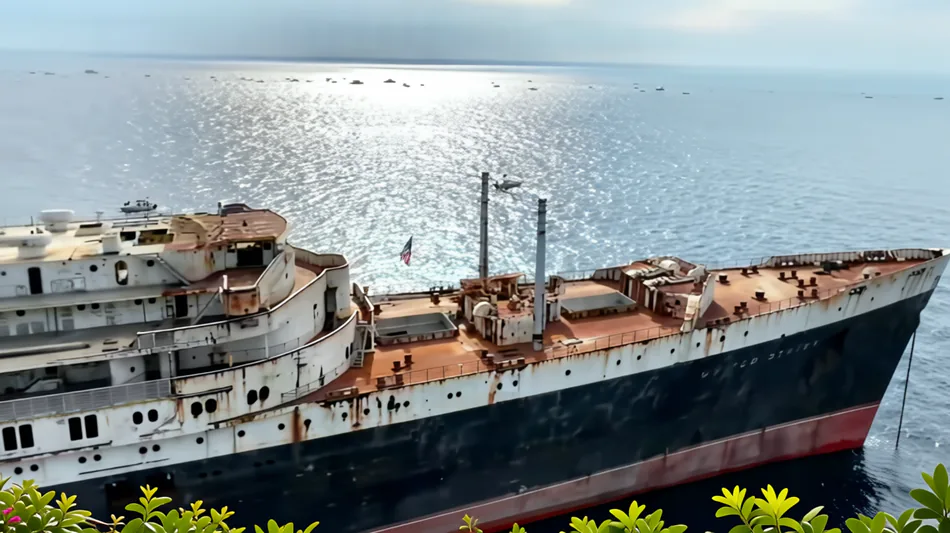
SS United States Sinks Off Florida Coast to Become World's Largest Artificial Reef
The SS United States, once the fastest transatlantic ocean liner in history, sank beneath the Gulf of Mexico on Wednesday evening, marking the end of its decades-long struggle for survival. The historic vessel is now set to become the world’s largest artificial reef, offering a new chapter for marine life and tourism off the coast of Florida.
The SS United States, the historic ocean liner that held the transatlantic speed record for over six decades, sank into the Gulf of Mexico on Wednesday evening, completing its transition from a floating relic to the world’s largest artificial reef.
The vessel began its final descent off Destin-Fort Walton Beach, Florida, during a Veterans Day ceremony that drew thousands of spectators and hundreds of thousands more via live stream. After remaining upright for several hours as it slowly filled with water, the 990-foot-long ship slipped beneath the surface shortly before midnight.
The sinking was a protracted event. Viewers on YouTube watched over 863,000 people observe the process from recreational boats and shorelines. The ship’s American flag was taken down by workers aboard before the final submersion. As night fell, floodlights from tugboats illuminated the darkening hull, which remained upright until its bow finally disappeared beneath the waves. The last visible element was the white lettering spelling "UNITED STATES" on the stern.
The SS United States, known as "the Big U" and "America’s Flagship," broke the transatlantic speed record in both directions in July 1952, traveling at speeds exceeding 38 knots. Its passenger list included U.S. presidents and celebrities. For decades, it sat on the Philadelphia waterfront, becoming a symbol of maritime history even as its structural integrity deteriorated.
The ship’s journey to this point was marked by years of uncertainty. Since 1996, the vessel had been subject to rental disputes and renovation challenges that prevented its preservation as a museum ship in Philadelphia. The nonprofit SS United States Conservancy, which had taken custody of the vessel, worked to prepare it for sinking after determining that maintaining the ship on land was no longer feasible.
The new location is approximately 22 nautical miles southwest of Destin-Fort Walton Beach at coordinates 30° 07.148′ N, 86° 46.755′ W. The site was chosen to create a substantial habitat for marine life. Scuba divers and marine scientists are expected to explore the wreck for years to come.
Over the next decade, experts and academics from the Woods Hole Oceanographic Institution, the Dauphin Island Sea Lab, and Louisiana State University will monitor the reef’s development. The goal is to ensure the structure supports biodiversity while remaining stable.
Local officials expressed optimism about the economic and cultural impact of the project. Okaloosa County Board Chairman Trey Goodwin described the event as historic for both the county and the ship. He noted that the vessel’s story would continue through visits to the wreck and a planned land-based museum.
Jennifer Adams, tourism director for Okaloosa County, highlighted the excitement within the local dive community. She described Destin-Fort Walton Beach as a small fishing village gaining a major attraction where visitors can fish, spearfish, and explore the site.
The SS United States Conservancy will retain significant components of the ship for its land-based museum. The two smokestacks, each 65 feet tall, were removed during the remediation process. Other preserved items include the liner’s propellers, radar mast, a cocktail bar, and various memorabilia gathered over the years.
Susan Gibbs, president of the conservancy and granddaughter of the ship’s designer, William Francis Gibbs, stated that incorporating these iconic elements into an architecturally designed museum would continue to inspire future generations. The land-based facility aims to complement the underwater experience by preserving the liner’s legacy on dry land.
The sinking concluded a long period of public engagement with the vessel. While many who grew up seeing the ship in Philadelphia found its final journey surreal, the project represents a definitive resolution to its preservation crisis. The SS United States will now serve as a permanent fixture of the Gulf Coast’s marine environment.
L.Konstantinou--AN-GR